Conventional grocery stores operate on 1.5%–2.5% net margins, which means a five-figure swing in federal tax is the difference between a good year and a flat one. Most independent operators still run their taxes on three defaults: a CPA who files the return, straight-line depreciation, and whatever the POS system assigns to sales tax.
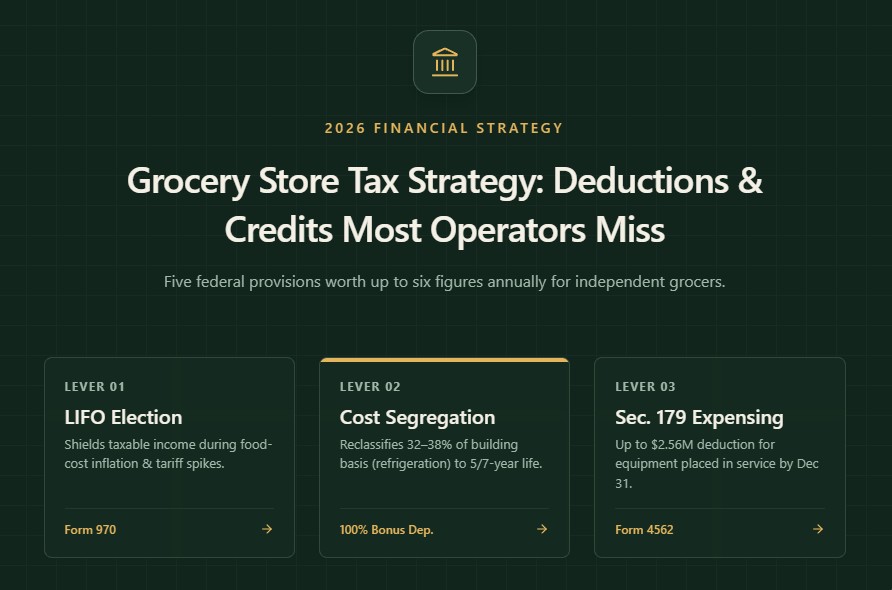
This guide covers the full stack for 2026 — the ordinary deductions every store takes, the safe harbors most miss, and the five provisions that can each be worth five to six figures a year for a $5–15 million grocer: LIFO inventory accounting, the $2,560,000 Section 179 deduction paired with 100% bonus depreciation, cost segregation on refrigeration and buildout, the Section 45B FICA tip credit, and the enhanced food-donation deduction. Every figure below carries its formula, dollar limit, filing deadline, and primary source, including what changed under H.R. 1 (Public Law 119-21, signed July 4, 2025), known in tax practice as the One Big Beautiful Bill Act (OBBBA). [GovTrack, Pub. L. 119-21] [Cornell Law, Wex]
Key Takeaways
- Section 179 cannot create a loss. The $2,560,000 ceiling is capped by your taxable business income — which, at a 2% net margin, is usually the binding constraint. Bonus depreciation has no income limit and can create a net operating loss.
- Most of these levers are deferrals, not forgiveness. LIFO, Section 179, bonus depreciation, and cost segregation move deductions forward and create recapture exposure on sale. Only the credits (45B, WOTC) and the enhanced donation deduction are permanent value.
- If you donate food, you must remove its cost from COGS first. Skipping that step is the single most common way an enhanced Section 170(e)(3) deduction turns into a double deduction the IRS disallows.
- Qualified Improvement Property (15-year) and Section 179 on roofs, HVAC, and fire/security systems matter more to a typical remodel than a full cost segregation study does.
- SNAP/EBT purchases are exempt from state and local sales tax nationwide under federal law, including in states that otherwise tax groceries.
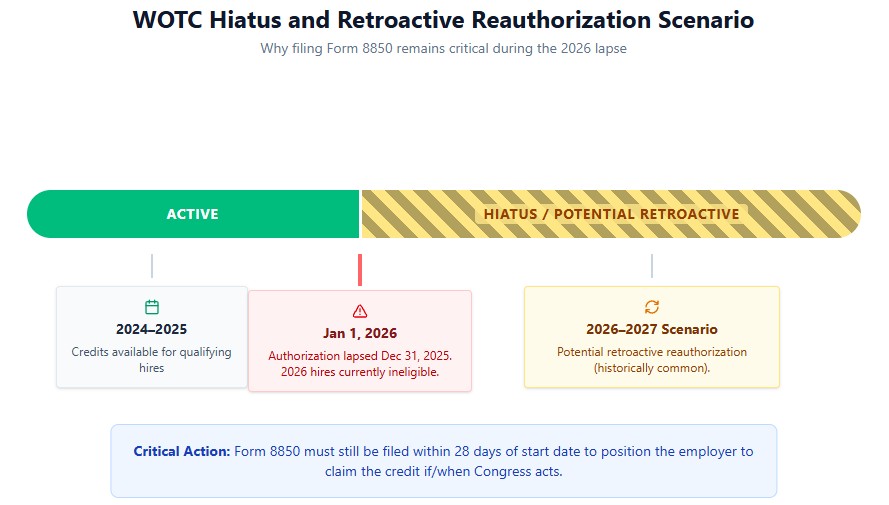
- WOTC is in hiatus for hires starting on or after January 1, 2026. Keep filing Form 8850 within 28 days anyway — the credit has been retroactively reauthorized after every prior lapse since 1996.
What’s In This Guide
- Why grocery tax strategy differs from generic small-business advice
- The baseline: what every grocery store deducts before any strategy
- Grocery tax levers at a glance
- How does the QBI deduction work for a grocery store in 2026?
- Should a grocery store elect LIFO — or use Section 471(c) instead?
- Section 179, bonus depreciation, QIP, and cost segregation
- Which states still tax groceries in 2026?
- Can a grocery store claim the FICA tip credit?
- What happened to WOTC in 2026?
- How does the food donation deduction work — and what’s the COGS trap?
- Multi-state and multi-unit complexity
- Deadline calendar
- Risk matrix: where these strategies go wrong
- 2026–2028 outlook
- Which strategies fit your format
- Frequently asked questions
A note on the law’s name: “One Big Beautiful Bill Act” was the bill’s title when it passed the House, but the short title was struck during Senate amendment under the Byrd Rule, so the statute has no official short title in the U.S. Code. The citations below point to Public Law 119-21 and the specific IRC sections it amended.
Why Grocery Tax Strategy Differs From Generic Small-Business Advice
Three structural facts separate grocery from a typical retail business for tax purposes:
- Inventory turns 12–20x a year and is inflation-sensitive. A boutique holds inventory for months; a grocery store’s perishables turn weekly. That turnover is what makes a LIFO election powerful in an inflationary or tariff-affected environment. Know your baseline inventory turnover ratio before modeling any of it.
- The building is a refrigeration machine with a roof, not a generic shell. Walk-in coolers, dedicated electrical for compressor loads, produce-mister plumbing, and specialty flooring are short-life assets typically buried inside a 39-year depreciation schedule.
- Every SKU carries its own sales tax classification. A hardware store charges one rate on almost everything. A grocery store’s shelves mix exempt food, taxable prepared food, taxable candy, taxable soda, taxable supplements, and tender-exempt SNAP transactions — sometimes on the same shelf tag run.
The Baseline: What Every Grocery Store Deducts Before Any Strategy
Advanced planning only pays once the ordinary layer is clean. These are the deductions that show up on essentially every independent grocery return, and the safe harbors that most single-location operators never elect.
Ordinary and Necessary Operating Deductions
| Category | Grocery-Specific Note |
|---|---|
| Cost of goods sold | The largest single deduction in the business; accuracy here outweighs every credit below. See how to calculate and reduce grocery COGS. |
| Rent or mortgage interest, property tax | If the building sits in a separate entity, review the self-rental rules discussed under QBI below. |
| Utilities | Refrigeration and HVAC typically make electricity the second- or third-largest controllable expense line in the store. |
| Payroll, payroll taxes, workers’ comp, benefits | Also the input to the QBI wage limitation and the 45B credit. |
| Card processing and interchange fees | At 1.5%–2.5% net margin, merchant fees can exceed net profit. Fully deductible and worth tracking as its own line, not buried in “bank charges.” |
| Licenses: alcohol, tobacco, food handling, weights and measures | Annual license fees are deductible; multi-year licenses are generally amortized over the license term. |
| Waste removal, organics/compost hauling, recycling fees | Rising in jurisdictions with organic-waste diversion mandates; pairs with the donation strategy below. |
| Insurance (property, liability, spoilage/equipment breakdown) | Spoilage coverage premiums are deductible; spoilage recoveries are income. |
| Advertising, circulars, loyalty program costs | Loyalty discounts reduce gross receipts rather than creating a separate deduction. |
| Vehicles used for delivery or supply runs | Actual expense or standard mileage; heavy vehicles have their own Section 179 cap (below). |
| Professional fees, POS software subscriptions, bank fees | Software subscriptions are ordinary expenses; perpetual licenses may be capitalized. |
Startup Costs Under Section 195
A new store can deduct up to $5,000 of startup expenditures and $5,000 of organizational costs in the year the business begins, with each $5,000 amount reduced dollar-for-dollar once total startup costs exceed $50,000 and the remainder amortized over 180 months. Pre-opening payroll, market research, site scouting, and training all count. Given typical grocery store opening costs, most new stores blow straight through the phase-out and amortize — but the election still has to be made on the first return. [26 U.S.C. §195]
Two Safe Harbors Most Independents Never Elect
| Safe Harbor | Threshold | Why It Matters for Grocery |
|---|---|---|
| De minimis safe harbor election (Treas. Reg. §1.263(a)-1(f)) | $2,500 per item or invoice line without an applicable financial statement; $5,000 with an audited AFS | A store replacing thirty $1,800 open-air display cases can expense all of them outright — no Section 179 election, no depreciation schedule, no recapture tracking. Requires a written capitalization policy in place at the start of the tax year. |
| Safe harbor for small taxpayers (Treas. Reg. §1.263(a)-3(h)) | Available to taxpayers with average annual gross receipts of $10 million or less, for buildings with an unadjusted basis of $1 million or less; annual cap is the lesser of 2% of unadjusted basis or $10,000 per building | Lets a smaller store expense routine repairs and maintenance that would otherwise be capitalized as improvements. |
Shrink: Deductible, But Only With Documentation
Spoilage and damage reduce taxable income automatically through COGS when inventory is physically written off. What the IRS will not accept is a plug figure. Treas. Reg. §1.471-2(c) requires that inventory written down below cost be supported by evidence of actual disposition or of a bona fide offering at the reduced price within a reasonable period. In practice that means dated shrink logs by department, disposal or donation receipts, and markdown records tied to specific SKUs — not a year-end estimate. Our guide to shrinkage in grocery stores covers the operational side; the tax side lives or dies on the paperwork.
Grocery Tax Levers at a Glance: Formulas, Limits, and Deadlines
| Lever | Formula / 2026 Limit | Filing Deadline | Governing Authority |
|---|---|---|---|
| Section 199A (QBI) deduction | 20% of QBI; wage/property limit = greater of 50% W-2 wages, or 25% W-2 wages + 2.5% UBIA of qualified property | Claimed on the annual return (Form 8995 or 8995-A) | IRC §199A, as amended by Pub. L. 119-21 |
| LIFO election | Inventory balance × annual cost-increase rate = current-year taxable income deferral | Form 970 filed with the return for the first year LIFO is used, by the due date including extensions | IRC §472; Treas. Reg. §1.472-3 |
| Section 179 expensing | Up to $2,560,000, capped by taxable business income; phase-out begins at $4,090,000; fully eliminated at $6,650,000 | Property placed in service by the last day of the tax year; claimed on Form 4562 | IRC §179; Rev. Proc. 2025-32 |
| Bonus depreciation | 100% of remaining basis after Section 179; no dollar cap, no income limitation | Property acquired after Jan. 19, 2025 and placed in service in the tax year claimed | IRC §168(k), as amended by Pub. L. 119-21 |
| Qualified Improvement Property | 15-year MACRS life; bonus-eligible | Placed in service in the year claimed | IRC §168(e)(6) |
| Cost segregation study | Reclassifies a meaningful share of building basis from 39-year to 5-, 7-, or 15-year life; food-service-heavy properties sit at the top of the range | No statutory deadline; placed-in-service year, or a look-back study any later year via Form 3115 | IRS Cost Segregation Audit Techniques Guide |
| Section 45B FICA tip credit | 7.65% of tips exceeding the amount needed to reach $5.15/hour (the federal minimum wage in effect Jan. 1, 2007) | Claimed annually on Form 8846; W-2 tipped-occupation coding must be accurate for the year claimed | IRC §45B; Form 8846 instructions |
| WOTC (in hiatus) | $2,400–$9,600 credit per qualifying hire, depending on target group | Form 8850 to the state workforce agency within 28 days of start date; credit claimed on Form 5884 | IRC §51; authorization lapsed Dec. 31, 2025 |
| Section 170(e)(3) food donation deduction | Lesser of (cost basis + 50% of appreciation) or (2× cost basis); capped at 15% of net income from the donating trade or business; cost must be removed from COGS | Claimed with the annual return; recipient must be a 501(c)(3) using the food for the ill, needy, or infants | IRC §170(e)(3)(C); Treas. Reg. §1.170A-4A(c)(3) |
How Does the QBI Deduction Work for a Grocery Store in 2026?
Most independent grocers operate as S-corps, partnerships, or LLCs taxed as pass-throughs specifically to access the Section 199A Qualified Business Income deduction — a 20% deduction that OBBBA made permanent, removing the sunset previously scheduled for the end of 2025.
QBI Mechanics for 2026
| Element | 2026 Formula / Threshold | Grocery-Specific Note |
|---|---|---|
| Base deduction | 20% of qualified business income | Grocery retail is not a specified service trade or business, so there is no income-based exclusion — only the wage/property limitation applies at higher incomes |
| Phase-in range (single filer) | Approximately $201,750–$276,750 taxable income | OBBBA widened this band from $50,000 to $75,000 above the threshold |
| Phase-in range (married filing jointly) | Approximately $403,500–$553,500 taxable income | OBBBA widened this band from $100,000 to $150,000 above the threshold |
| Wage/property limitation above the phase-in | Greater of: (a) 50% of W-2 wages paid by the business, or (b) 25% of W-2 wages + 2.5% of unadjusted basis immediately after acquisition (UBIA) of qualified property | Grocery’s heavy real estate and equipment basis helps clear this test even in labor-light formats |
| Minimum deduction | $400 minimum if QBI is at least $1,000 and the owner materially participates | Introduced by OBBBA for tax years beginning after 2025; protects small, high-basis owners who would otherwise calculate close to zero |
Sources: Pub. L. 119-21; IRS Rev. Proc. 2025-32 (2026 inflation adjustments); 26 U.S.C. §199A.
Why the wage/property formula favors grocery: the limitation explicitly rewards businesses with heavy unadjusted basis in qualified property — exactly what separates grocery from a low-capital service business. A cost segregation study does not just accelerate depreciation; it documents a higher, component-level UBIA figure that supports a larger QBI deduction once income clears the phase-in range.
The OpCo/PropCo Structure and the Self-Rental Rule
The most common independent grocery structure — the building held in a separate LLC that leases to the operating entity — creates two Section 199A questions that generic small-business content skips entirely.
- Self-rental. Rental to a commonly controlled operating business is treated as a trade or business for Section 199A purposes under Treas. Reg. §1.199A-1(b)(14), so the rent income generally qualifies as QBI even if the property LLC would not otherwise rise to the level of a trade or business. Common control is the test, and the rental entity must be able to prove it.
- Aggregation. Treas. Reg. §1.199A-4 permits aggregating the operating company and the property company into a single trade or business, which pools the OpCo’s W-2 wages with the PropCo’s UBIA. This is often the difference between clearing and failing the wage/property limitation, because the PropCo has basis but almost no payroll and the OpCo has payroll but often little basis. The election is made on the return, must be disclosed annually, and once made is binding in later years.
Whether to hold real estate in a separate entity at all is a structural question that sits alongside the buy vs. lease decision — and it is easier to set up correctly at acquisition than to restructure afterward.
Should a Grocery Store Elect LIFO — or Use Section 471(c) Instead?
Last-In, First-Out inventory accounting assumes the most recently purchased inventory is sold first, so cost of goods sold reflects current, higher prices rather than older, cheaper ones — producing lower taxable income than FIFO when costs are rising.
The Formula
The first-year benefit is straightforward:
Year-end inventory balance × effective annual cost-increase rate = current-year taxable income deferral
Worked example: a grocer carrying a $1.5M average inventory balance in a year with 4% effective food-cost inflation defers roughly $60,000 of taxable income. At a 30% combined marginal rate, that is about $18,000 of cash retained in year one.
Read the word “defers” literally. LIFO does not eliminate tax. It builds a LIFO reserve — the cumulative gap between LIFO and FIFO valuation — that becomes taxable income whenever inventory levels drop (a LIFO layer liquidation), on conversion to a C-corporation, or in certain M&A structures. The benefit is the time value of money on a deferral that can run for decades, plus a permanent benefit only if the business is eventually sold in a structure where the reserve is never recaptured.
The Filing Deadline
Treas. Reg. §1.472-3 requires the LIFO election to be made by filing Form 970, Application to Use LIFO Inventory Method, with the income tax return for the first taxable year the method is used — meaning by the return’s due date, including any extensions actually filed. Missing the deadline is not automatically fatal; the IRS has granted late-election relief under Treas. Reg. §301.9100 in multiple private letter rulings, but relief requires demonstrating good cause, costs money, and is never guaranteed.
Why 2025–2026 Is a Specific Window
Elevated food inflation and the 2025 tariff round on imported produce widened the gap between older and newer inventory cost layers — precisely the gap LIFO monetizes. Treat this as a time-limited window rather than a standing recommendation: tariff pass-through to shelf prices is expected to peak in 2026 and moderate afterward, and LIFO only pays while costs are rising.
What It Costs You to Elect It
| Requirement | Detail |
|---|---|
| Book-tax conformity (IRC §472(c)) | If you use LIFO for tax, you must also use it for financial statement reporting. Reported net income falls — which can breach loan covenants tied to net income or debt-service coverage. Talk to your lender before you elect, not after. |
| LIFO reserve tracking | The gap between LIFO and FIFO valuation must be computed and carried every year, typically using a published inflation index for retail grocery pools. This is real annual accounting cost. |
| Works only with rising costs | If your category mix trends toward flat or falling wholesale prices, the benefit shrinks. Revoking LIFO requires IRS consent via Form 3115 and generally triggers recapture of the reserve over four years. |
The Alternative Most Grocers Are Never Shown: Section 471(c)
A business that meets the gross receipts test of IRC §448(c) — average annual gross receipts of $31 million or less for 2026, tested over the prior three years — is exempt from the UNICAP rules of §263A and may, under IRC §471(c), treat inventory either as non-incidental materials and supplies or in conformity with its books. That effectively allows inventory cost to be deducted when the goods are sold or used, without maintaining a formal tax inventory method at all.
This is a genuine fork, not a complement:
| LIFO election | Section 471(c) treatment | |
|---|---|---|
| Who qualifies | Any taxpayer | Gross receipts ≤ $31M (2026) |
| Benefit source | Cost inflation on a large inventory balance | Simplification; removes UNICAP capitalization of indirect costs into inventory |
| Annual compliance cost | High — index computation, reserve tracking, book conformity | Low |
| Book conformity required | Yes | Conformity to books is one of the permitted approaches, not a constraint |
| Best fit | $1M+ inventory balance, inflationary period, no covenant pressure | Smaller stores where the LIFO benefit does not cover the accounting fee |
The practical screen: multiply your average inventory balance by your realistic cost-increase rate, then by your marginal rate. If the result does not comfortably exceed the annual cost of LIFO computation and the covenant risk, Section 471(c) is the better answer and LIFO is a distraction. For a corner store with $180,000 of inventory, a 4% inflation year produces roughly $7,200 of deferred income — LIFO is not worth the filing.
Section 179, Bonus Depreciation, QIP, and Cost Segregation: The Grocery Depreciation Stack
This is the largest lever available to an operator who owns their building or is doing a major buildout — but only if the pieces are stacked in the right order and against the right constraint.
The 2026 Numbers and Placed-in-Service Deadlines
| Provision | 2026 Limit / Rate | Deadline |
|---|---|---|
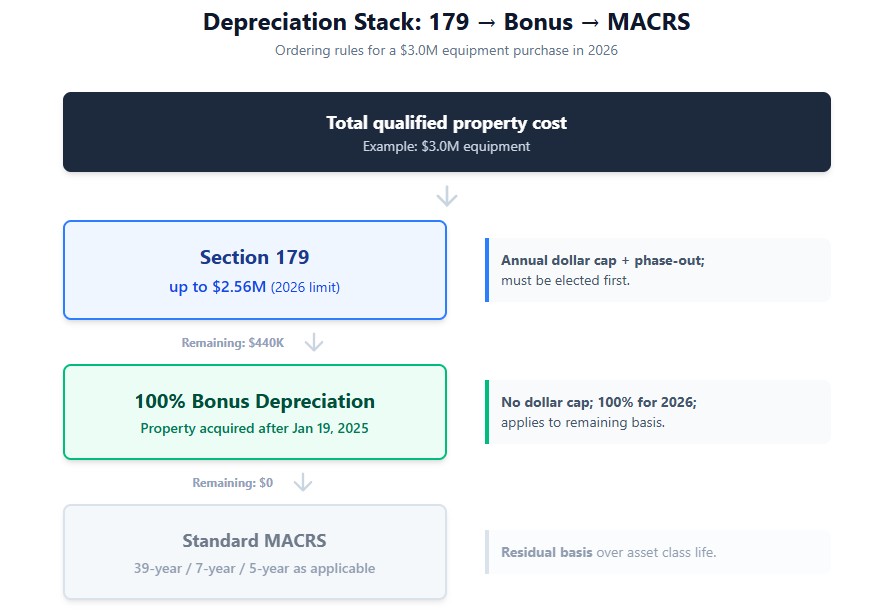
| Section 179 maximum deduction | $2,560,000 | Placed in service by Dec. 31, 2026 for calendar-year filers |
| Section 179 phase-out | Begins at $4,090,000 of qualifying purchases; fully eliminated at $6,650,000 | Same as above |
| Section 179 taxable income limitation | Deduction cannot exceed aggregate taxable income from the active conduct of a trade or business; excess carries forward indefinitely | Applies at the entity and, for pass-throughs, again at the owner level |
| Heavy vehicle cap | $32,000 first-year Section 179 on SUVs 6,000–14,000 lbs GVWR; remaining basis takes bonus | Same as above |
| Bonus depreciation | 100% of remaining basis after Section 179; no dollar cap, no phase-out, no income limitation, and it can create a net operating loss | Property acquired after Jan. 19, 2025 and placed in service in the year claimed |
| Qualified Improvement Property | 15-year MACRS, bonus-eligible | Improvement placed in service after the building was first placed in service |
Sources: Rev. Proc. 2025-32; IRS Publication 946; 26 U.S.C. §179; 26 U.S.C. §168(k).
The Constraint That Actually Binds: Section 179 Cannot Create a Loss
This is the single most misunderstood point in grocery depreciation planning, and it follows directly from the industry’s margin structure. Section 179 is capped at your aggregate taxable income from the active conduct of a trade or business. A store doing $10 million in sales at a 2% net margin has roughly $200,000 of taxable business income. Its Section 179 ceiling that year is therefore about $200,000 — not $2,560,000 — regardless of how much equipment it buys. The unused amount carries forward indefinitely, but it does not reduce this year’s tax.
Bonus depreciation has no such limitation. It can drive taxable income negative and generate a net operating loss. For a thin-margin grocer placing significant equipment in service, bonus is usually the more powerful of the two provisions, and the conventional “elect 179 first” advice needs to be tested against the income limitation rather than applied mechanically.
Ordering Rule
Section 179 is elected first, then bonus depreciation applies to the remaining basis, then standard MACRS covers anything left. Two reasons to think before following the default order:
- Section 179 is elected asset-by-asset, so it can be targeted at property with the longest recovery period or at property in a state that allows 179 but decouples from bonus.
- Because Section 179 is income-limited and bonus is not, electing 179 on property that bonus would fully expense anyway wastes the election without adding a dollar of deduction.
Before You Commission a Study: QIP and Building Systems Under Section 179
Two provisions handle most of a typical remodel without an engineering study at all, and both are routinely missed.
| Provision | What It Covers | Treatment |
|---|---|---|
| Qualified Improvement Property (IRC §168(e)(6)) | Improvements to the interior of an existing nonresidential building, placed in service after the building was. Excludes building enlargement, elevators and escalators, and internal structural framework. | 15-year MACRS and bonus-eligible — so a qualifying interior remodel is generally 100% deductible in year one for property acquired after Jan. 19, 2025. This is the provision that covers most grocery buildouts. |
| Section 179 on building systems (IRC §179(f)) | Roofs, HVAC, fire protection and alarm systems, and security systems on nonresidential real property | Eligible for Section 179 expensing (subject to the dollar and income limits above). For a building whose HVAC and refrigeration load is the defining capital expense, this is a large category. |
Work through QIP and Section 179(f) first. A cost segregation study is the right tool for a purchased or newly constructed building, not for a $400,000 interior refresh that QIP already fully expenses.
Cost Segregation: Where Refrigeration Becomes a Tax Asset
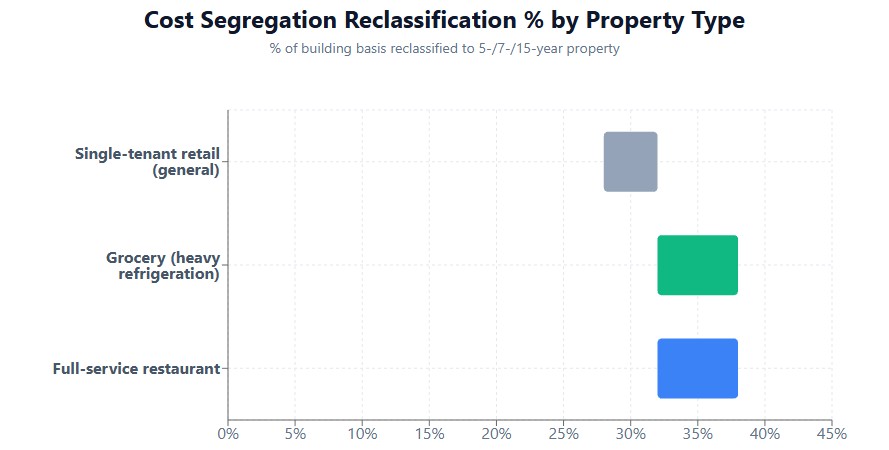
Nonresidential real estate defaults to a 39-year depreciation schedule. A cost segregation study is an engineering-based analysis that reclassifies specific building components into 5-, 7-, or 15-year MACRS classes. Reclassification rates scale with a property’s equipment and site-work density: general single-tenant retail typically lands in the high twenties to low thirties as a percentage of building basis, while properties with heavy food-service or refrigeration infrastructure — the category grocery falls into — reach the mid-to-high thirties, comparable to full-service restaurant buildouts. Vendor-published ranges vary widely and should be treated as a planning estimate, not a promise; the study itself produces the number.
| Component | Typical Reclassified Life | Why It Qualifies |
|---|---|---|
| Refrigerated display cases, walk-in coolers and freezers | 5–7 years | Removable, specialized equipment tied to merchandising — a walk-in cooler box is a freestanding insulated enclosure, not part of the building structure |
| Dedicated electrical and plumbing serving refrigeration | 5–7 years | Installed specifically to support equipment, not general building systems |
| Checkout stations, specialty and accent lighting | 5–7 years | Fixtures tied to a specific retail function |
| Millwork, shelving, decorative elements | 7–15 years | Non-structural finish and fixture work |
| Parking lot, site lighting, landscaping | 15 years | Land improvements depreciate faster than the building itself |
| Core structure (walls, roof, foundation) | 39 years | Remains on the standard schedule |
Worked Example: A 30,000 Sq. Ft. Grocery Store
| Input | Value |
|---|---|
| Total building cost basis (excluding land) | $9,000,000 |
| Reclassified to 5-, 7-, and 15-year property at 32% | $2,880,000 |
| Remaining on the 39-year schedule | $6,120,000 |
| With 100% bonus applied to the reclassified portion | The full $2,880,000 becomes a first-year deduction instead of being spread across up to 39 years |
| Deduction taken via bonus, not Section 179 | Not subject to the taxable income limitation — this deduction can create an NOL, unlike a Section 179 election of the same amount |
The 2026-specific point: because bonus depreciation is 100% for qualifying property acquired after January 19, 2025, every dollar a study reclassifies into a 5-, 7-, or 15-year bucket is not merely accelerated — it is fully expensed in year one. Before OBBBA, cost segregation only changed when a deduction landed. Now it can determine whether a large share of building basis is deducted in year one versus over 15 to 39 years, which moves the decision from “worth doing eventually” to “worth commissioning before the first tax filing after acquisition or remodel.” A look-back study filed via Form 3115 can also generate a §481(a) catch-up adjustment in the current year on a store purchased or built years ago — though bonus treatment on a look-back depends on when the property was acquired, so a 2012 building will produce accelerated MACRS, not a 100% first-year write-off.
Three Limits That Cap the Whole Stack
| Limit | Effect on a Grocery Operator |
|---|---|
| Depreciation recapture (IRC §1245 and §1250) | Everything reclassified into a short life is §1245 property. On sale, accumulated depreciation on that property is recaptured as ordinary income rather than taxed at capital gain rates. Cost segregation converts a future capital gain into future ordinary income in exchange for a present-value benefit — a good trade in most cases, but a trade, not free money. |
| Excess business loss limitation (IRC §461(l)) | Made permanent by OBBBA. A non-corporate taxpayer cannot use business losses above an inflation-adjusted threshold (roughly $313,000 single / $626,000 joint for 2026) against non-business income in the current year; the excess converts to an NOL carryforward. Stacking bonus depreciation aggressively can push a large part of the intended benefit into future years. |
| Business interest limitation (IRC §163(j)) | OBBBA restored the EBITDA-based computation, which adds depreciation and amortization back to adjusted taxable income and therefore raises the interest deduction ceiling. Helpful for leveraged grocers, and a reason to model interest and depreciation together rather than separately. Businesses meeting the §448(c) gross receipts test are exempt from §163(j) entirely. |
State Conformity: Do Not Assume the Federal Deduction Flows Through
States take three positions on the federal depreciation rules, and the difference can be six figures for a multi-state operator.
| Posture | What It Means | Representative States |
|---|---|---|
| Full or near-full conformity | Federal Section 179 and bonus flow through with no add-back | Most rolling-conformity states, including Illinois for 179 and a majority of Southeastern states |
| Decoupled from bonus, conforms to 179 | Bonus is added back and depreciated over the state schedule; the 179 deduction is allowed, sometimes at a reduced cap | New York, New Jersey, Pennsylvania, Ohio (with a multi-year add-back and spread), Maryland, Virginia, North Carolina |
| Decoupled from both, with its own 179 cap | Bonus disallowed and the Section 179 deduction capped far below the federal amount | California (Section 179 capped at $25,000 with a $200,000 investment phase-out; no bonus), plus several states with their own dollar limits |
Verify the current-year posture with each state’s department of revenue before modeling; conformity dates are amended frequently, often retroactively.
Which States Still Tax Groceries in 2026?
A single grocery shelf can carry four different sales tax outcomes on four items, and a fifth depending on how the customer pays. Misclassification at scale is a recurring audit finding, not a theoretical risk.
The Three-Tier National Map
Tier 1 — No statewide sales tax (5 states): Alaska, Delaware, Montana, New Hampshire, Oregon. Groceries are untaxed at the state level by default. Alaska is the exception where local boroughs and municipalities can and do impose their own sales tax on groceries.
Tier 2 — Groceries exempt at the state level (roughly 36 states): including California, Texas, New York, Florida, Pennsylvania, Ohio, and Michigan. The exemption covers only unprepared food intended for home consumption — see the compliance traps below. A state-level exemption does not mean a tax-free register: see the local add-on section.
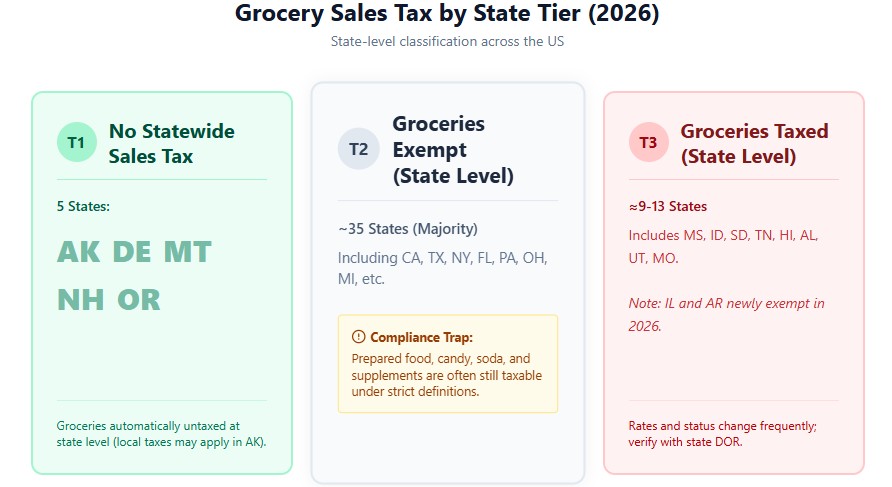
Tier 3 — Groceries still taxed at the state level (approximately 9 states):
| State | 2026 State Grocery Rate | Trend |
|---|---|---|
| Idaho | 6% (the full state rate, offset by a refundable grocery income tax credit of roughly $155 per person) | Stable, with income-tax offset |
| Mississippi | 5% (cut from 7% in July 2025; further phased reductions scheduled) | Falling |
| South Dakota | 4.2% (temporary reduction from 4.5%) | Falling, scheduled to revert |
| Tennessee | 4% (reduced from the 7% general rate; local jurisdictions can add up to 2.75%) | Stable |
| Hawaii | ~4% General Excise Tax — a broad gross receipts tax, not a traditional sales tax, that applies to groceries | Stable |
| Utah | 3% combined reduced rate (1.75% state plus local increments) | Stable |
| Alabama | 2%. Act 2026-604 suspended the state portion entirely from May 1 through June 30, 2026; the holiday ended and the 2% rate resumed July 1, 2026. Local city and county taxes were never suspended. [Alabama DOR notice] | Falling; full repeal is an active 2026 legislative and campaign issue |
| Missouri | 1.225% state; local combined rates can push the total above 8% in some jurisdictions | Under legislative review |
| Arkansas | Eliminated effective Jan. 1, 2026 | Newly exempt |
| Illinois | State 1% eliminated effective Jan. 1, 2026; municipalities were authorized to enact their own 1% local grocery tax, and many did | Exempt at state level only |
Recently eliminated, for trend context: Virginia removed the 1.5% state portion in 2023 but the 1% local option remains in effect. Oklahoma eliminated the 4.5% state grocery tax effective August 2024, with local sales taxes still applying. Kansas completed its phase-out in January 2025. Arkansas and Illinois followed in January 2026. The direction is consistent; the local layer usually survives.
Local Add-Ons Inside “Exempt” States
A state-level exemption is not the end of the analysis. States where local jurisdictions can tax groceries even though the state does not, or at rates differing from the state treatment, include Alabama, Alaska, Arizona, Colorado (home-rule cities), Georgia, Illinois, Louisiana, Missouri, North Carolina, South Carolina, Tennessee, Utah, and Virginia. Map rates by store location, not by state law — two of your stores in the same state can owe different tax on identical items.
Three Compliance Traps Inside Exempt States
- The heating test: food heated by the seller before sale is prepared food and is taxable, even a commodity item like rotisserie chicken, regardless of whether groceries are generally exempt.
- The cutlery test: food sold with a fork, spoon, or napkin provided by the seller often crosses into taxable prepared-food territory even when served cold. Several states apply a percentage threshold: if prepared food exceeds a set share of total food sales, utensils being “made available” is enough to taxify items that would otherwise be exempt.
- The candy/flour distinction: most states following the Streamlined Sales Tax definitions classify a candy bar containing flour as food — exempt in an exempt state — while a bar without flour is classified as candy and taxed, on the same shelf, in the same state. Dietary supplements, vitamins, and protein powders are typically taxable even where groceries are broadly exempt, and are distinguished from food by the presence of a Supplement Facts panel.
SNAP/EBT: The Exemption That Overrides Everything
Under federal law (7 U.S.C. §2013(a)), state and local governments are prohibited from collecting sales tax on items purchased with SNAP benefits. This applies everywhere, including in the nine states that otherwise tax groceries. Two practical consequences that generic sales tax content never addresses:
- Split tender is where errors happen. When a customer pays part of a basket with EBT and part with cash or card, the POS must allocate the SNAP tender to eligible items first and compute tax only on the remainder. Misconfigured allocation logic over-collects tax from low-income customers — which is both a compliance problem and a refund liability.
- Taxable items are never SNAP-eligible, and vice versa, but the sets are not mirror images. Hot prepared food is taxable and SNAP-ineligible; cold deli items may be SNAP-eligible and exempt; energy drinks with a Supplement Facts panel are SNAP-ineligible and usually taxable. Your POS needs both flags per SKU, maintained independently.
Coupons, Discounts, and the Taxable Base
One of the most common audit findings in grocery has nothing to do with product classification:
- Store coupons and loyalty discounts reduce the amount the retailer actually receives, so in most states they reduce the taxable base. Tax is computed on the discounted price.
- Manufacturer coupons are reimbursed to the retailer by a third party. In most states, that reimbursement is part of the consideration received, so tax is computed on the pre-coupon price. Treating manufacturer coupons like store coupons systematically under-collects tax on every promoted SKU — an error that compounds across every circular cycle.
- Buy-one-get-one and free-item promotions have state-specific treatment, and a handful of states tax the retailer’s cost of the “free” item.
Levies That Are Not Sales Tax But Hit the Same Register
| Levy | Where It Applies | What to Get Right |
|---|---|---|
| Sweetened beverage taxes | Philadelphia, Seattle, Boulder, Berkeley, Oakland, San Francisco, and other localities | Usually levied on the distributor but passed through at shelf; whether the pass-through amount is itself subject to sales tax varies by jurisdiction |
| Container deposits | Ten states with bottle bills | Deposits are generally not part of the taxable sales price and are tracked as a liability, not revenue |
| Carryout bag fees | Growing list of states and municipalities | Some fees are retained by the retailer as taxable revenue; others are remitted to the jurisdiction. Treatment differs by ordinance. |
| Alcohol and tobacco excise and licensing | All states | Excise is generally embedded in cost and flows through COGS; license fees are deductible operating expense |
| Lottery commissions | State lottery states | Ticket sales are agency receipts, not gross revenue. Only the commission is income. Reporting gross ticket sales as revenue inflates receipts and can push a store past gross-receipts thresholds such as §448(c). |
Deli and bakery carry the highest gross margins in the store (55%–65% and 50%–60% respectively). Misclassifying those same high-margin SKUs as exempt when they legally qualify as prepared food is one of the more expensive audit findings in the industry. A quarterly SKU-level taxability audit, mapped against your state’s heating and cutlery tests, is inexpensive insurance against a five- or six-figure back-assessment — particularly for stores running a private label strategy, where proprietary prepared foods often have no obvious classification precedent.
Can a Grocery Store Claim the FICA Tip Credit?
Yes — and most do not. Form 8846 and the underlying statute define eligibility around an activity, not a business category: any employer whose employees receive tips for providing, delivering, or serving food or beverages, where tipping is customary, can claim the credit. The statute never says “restaurant.” That covers a made-to-order deli counter, a sushi bar, a juice bar, or an in-store coffee counter with a tip line on the POS. [IRS, About Form 8846] [26 U.S.C. §45B]
Formula: 7.65% — the employer’s share of Social Security and Medicare tax — of qualifying tips that exceed the amount needed to bring an employee’s cash wage up to $5.15 per hour. That figure is the federal minimum wage in effect on January 1, 2007, and it remains the fixed statutory baseline for this credit regardless of how much the actual minimum wage has since risen. Because most grocery deli staff are already paid well above $5.15 in straight wages, nearly all reported tips qualify.
Mechanics that determine whether you actually keep it:
- The credit reduces your deduction dollar-for-dollar. Claiming §45B means you cannot also deduct the FICA and Medicare tax paid on those same tips. It is a credit-or-deduction choice on that specific liability, not a stack of both. The credit is still worth more than the deduction at any realistic marginal rate.
- It is part of the general business credit. The §45B credit flows into Form 3800 and is subject to the §38 limitation, with a one-year carryback and twenty-year carryforward. A store with little current tax liability may not monetize it this year.
- Only tips the employee actually reports count. Unreported tips produce no credit, which makes POS tip capture and employee reporting compliance the operational precondition.
What’s new for 2026: employers must separately report qualified cash tips on employee W-2s using a Treasury-assigned tipped occupation code. This is a payroll reporting requirement layered on top of the credit calculation, and it is distinct from OBBBA’s separate employee-side deduction for tip income, which affects employee income tax rather than employer FICA. Before you configure payroll, confirm that the occupation your deli or coffee-counter staff are coded to appears on Treasury’s published list of occupations that customarily and regularly receive tips — a food-counter attendant and a general grocery clerk are not the same code, and coding the wrong one jeopardizes both the employee’s deduction and your credit substantiation.
What Happened to WOTC in 2026 — and Should You Keep Screening?
The Work Opportunity Tax Credit rewards employers for hiring from designated target groups — SNAP recipients, qualified veterans, the long-term unemployed, ex-felons, designated community residents — with a credit of $2,400 to $9,600 per qualifying hire depending on the group. Its authorization lapsed on December 31, 2025. Authority to claim the credit based on wages paid after that date has lapsed, so employees who began work on or after January 1, 2026 do not currently generate a credit. [Congressional Research Service, R43729]
Keep screening anyway. State workforce agencies are continuing to accept, date-stamp, log, and retain Form 8850 and ETA Form 9061 submissions for 2026 start dates under Department of Labor guidance, but cannot issue certifications or denials until Congress acts. Congress appropriated funds for state WOTC administration in the Consolidated Appropriations Act, 2026 specifically so that agencies could keep processing during the lapse. WOTC has lapsed and been reauthorized — frequently retroactively — multiple times since its creation in 1996. A grocer who keeps documenting eligible 2026 hires is positioned to capture the credit the moment Congress acts; one who stops screening forfeits that population permanently, because the 28-day window cannot be reopened after the fact.
Filing mechanics: Form 8850 must reach the state workforce agency within 28 calendar days of the employee’s start date — not the day of the job offer, and not within one business day. ETA Form 9061 accompanies it. Once certified, the credit itself is claimed on Form 5884 and carried to Form 3800 as part of the general business credit.
How Does the Food Donation Deduction Work — and What’s the COGS Trap?
Produce carries the highest shrink rate in the store, and produce alone accounts for roughly 31% of surplus food industry-wide. Most of that shrink is treated purely as a loss. Section 170(e)(3) offers an enhanced deduction for grocery stores, restaurants, and farms that donate wholesome but unsellable inventory to a qualifying 501(c)(3) instead of discarding it. [26 U.S.C. §170(e)(3)]
The Formula
| Step | Calculation | Worked Example |
|---|---|---|
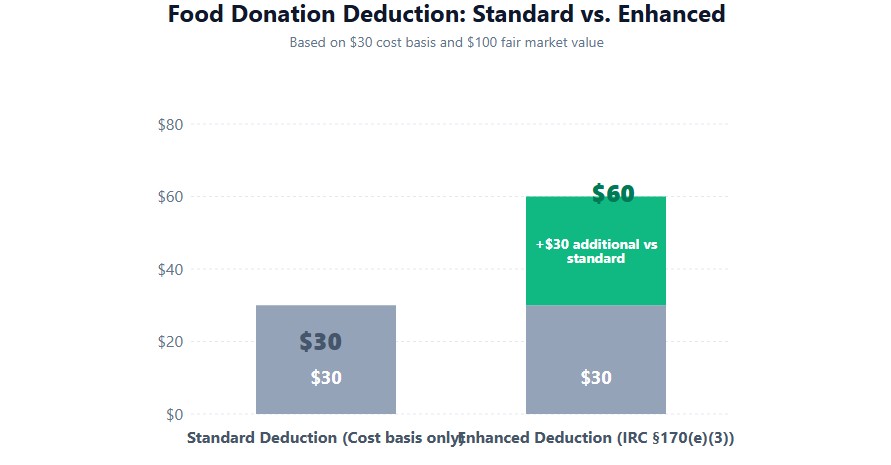
| 1. Cost basis of donated food | Direct plus allocable indirect cost | $30 of potatoes with $100 fair market value |
| 2. Expected profit | Fair market value − cost basis | $100 − $30 = $70 |
| 3. Enhanced deduction | Lesser of (basis + 50% of expected profit) or (2× basis) | Lesser of ($30 + $35 = $65) or ($60) → $60 |
| Result vs. the standard rule | Without §170(e)(3), the deduction is limited to the $30 basis | The enhanced deduction doubles the write-off |
The COGS Trap — The Step Almost Everyone Skips
Here is where most grocery donation programs create an exposure instead of a benefit. Your donated food has already run through cost of goods sold — you bought it, it entered inventory, and it left inventory when you gave it away. If you then claim a charitable deduction that includes the basis without adjusting COGS, you have deducted the same $30 twice.
Treas. Reg. §1.170A-4A(c)(3) resolves this: where donated property is included in the taxpayer’s opening inventory or is purchased during the year, the cost of that property must be removed from cost of goods sold before the charitable contribution deduction is computed. The mechanics:
- Identify the cost basis of donated inventory for the year (dated donation logs by department, priced at cost).
- Remove that basis from COGS — increasing gross profit by that amount.
- Claim the enhanced deduction (in the example, $60) as a charitable contribution.
Net effect in the example: taxable income increases by $30 through COGS and decreases by $60 through the deduction, for a net $30 benefit — exactly the enhancement over the ordinary basis deduction, and nothing more. A program that skips step 2 is claiming $60 on top of a $30 deduction already taken, and the entire enhancement is disallowable on audit.
Ceilings and the New Floors
| Limitation | Applies To | Amount |
|---|---|---|
| Enhanced deduction ceiling | Non-C-corporation donors | 15% of net income from the trade or business making the donation |
| Enhanced deduction ceiling | C corporations | 15% of taxable income |
| Charitable floor (OBBBA, effective for tax years beginning after Dec. 31, 2025) | Individuals, including owners of pass-through entities | Only contributions above 0.5% of adjusted gross income are deductible |
| Charitable floor (OBBBA) | C corporations | Only contributions above 1% of taxable income are deductible; the existing 10% ceiling continues to apply |
How the floor cuts: a small independent grocer with modest AGI and an occasional food-bank donation may find the new floor absorbs most of a small donation’s deductibility. A grocer running a systematic program — routing near-date dairy, bakery, and produce to a food bank on a set weekly schedule — clears the floor easily and captures the full enhanced benefit on a program that simultaneously reduces shrink, cuts organic-waste hauling cost, and generates liability protection under the Bill Emerson Good Samaritan Food Donation Act. Sporadic donation is now the worst of both worlds: administratively annoying and largely non-deductible.
Multi-State and Multi-Unit Tax Complexity
| Issue | Why It Applies to Grocery | Action |
|---|---|---|
| Economic sales tax nexus | Delivery and marketplace integrations can create taxable presence in states where you have no physical store | Confirm whether your delivery platform is acting as a marketplace facilitator collecting on your behalf, or whether the obligation sits with you. Get it in writing from the platform. |
| State corporate income apportionment | Multi-unit chains apportion income across states, often under single-sales-factor rules | Coordinate apportionment methodology with LIFO and cost segregation timing — moving inventory or fixed-asset basis between states shifts where deductions land |
| State conformity to bonus and Section 179 | See the conformity table above; several large states decouple | Model state add-backs before assuming a federal deduction flows through dollar-for-dollar |
| Local grocery tax add-ons | Thirteen-plus states allow local grocery taxation regardless of state treatment | Map rates by store location, not by state law |
| State-level donation and hiring credits | Several states offer their own food-donation credits and hiring incentives that survive the federal WOTC hiatus | Check state credits independently; they are not affected by federal reauthorization timing |
Deadline Calendar: What to File and When
| Action | Deadline | Form |
|---|---|---|
| Adopt a written capitalization policy for the de minimis safe harbor | In place by the first day of the tax year | Internal policy; election statement with the return |
| Elect LIFO inventory accounting | By the due date, including extensions, of the return for the first year LIFO is used | Form 970 |
| Place equipment and vehicles in service for Section 179 | By the last day of the tax year | Form 4562 |
| Place qualifying property in service for 100% bonus depreciation | Acquired after Jan. 19, 2025; placed in service in the year claimed | Form 4562 |
| Commission a cost segregation look-back study on prior-year real estate | No statutory deadline; file the accounting method change with the current-year return | Form 3115 |
| Submit WOTC pre-screening for a new hire | Within 28 calendar days of the employee’s start date (certifications on hold pending reauthorization) | Form 8850 + ETA Form 9061 |
| Claim WOTC once certified | With the annual return | Form 5884, carried to Form 3800 |
| Claim the FICA tip credit | With the annual return; W-2 tipped-occupation coding must be accurate for the year claimed | Form 8846, carried to Form 3800 |
| Claim the enhanced food donation deduction | With the annual return, for donations made during the tax year; remove donated basis from COGS in the same year | Entity return with Form 8283 where required; flows to owners via Schedule K-1 for pass-throughs |
| Claim the QBI deduction | With the annual individual return; aggregation must be disclosed annually | Form 8995 or 8995-A |
Risk Matrix: Where These Strategies Go Wrong
| Risk | Trigger | Mitigation |
|---|---|---|
| Section 179 election wasted against the income limit | Electing the full statutory amount at a 2% net margin, where taxable business income caps the deduction far below the ceiling | Compute the income limitation first; push the excess to bonus depreciation, which has no income cap |
| Depreciation recapture at sale | Reclassified §1245 property is recaptured as ordinary income when the store is sold | Model the exit before commissioning a study; the trade is usually still favorable, but it should be a decision, not a surprise |
| LIFO reserve recapture | Layer liquidation, C-corp conversion, or certain M&A structures | Model recapture exposure before any entity conversion or sale; time the transaction around it |
| LIFO covenant breach | Book-tax conformity depresses reported net income, tripping a DSCR or net income covenant | Model the covenant impact and notify the lender before electing |
| Double-deducted food donations | Claiming the enhanced deduction without removing donated basis from COGS | Build the COGS adjustment into the monthly donation log, not the year-end return |
| Cost segregation without an engineering study | A study built on percentage rules of thumb rather than measured component detail; the IRS Audit Techniques Guide favors engineering-based studies | Use a firm that documents refrigeration loads, electrical runs, and site work component by component |
| Sales tax misclassification at deli and bakery | Treating prepared, heated, or utensil-served food as exempt because it is sold from a grocery department | Run a quarterly SKU taxability audit against your state’s heating and cutlery tests |
| Manufacturer coupon under-collection | Computing tax on the post-coupon price for reimbursed manufacturer coupons | Configure the POS to distinguish reimbursed from non-reimbursed discounts |
| SNAP split-tender over-collection | POS allocates non-SNAP tender to SNAP-eligible items, producing tax on an exempt purchase | Test split-tender allocation logic against actual baskets, not vendor documentation |
| FICA tip credit substantiation gaps | Claiming the credit without accurate W-2 tipped-occupation coding or clean POS tip capture | Confirm payroll and POS both support the 2026 occupation-code requirement before filing Form 8846 |
| WOTC screening abandoned during hiatus | Assuming the lapse means “don’t bother” and dropping Form 8850 screening | Keep filing within the 28-day window; the window cannot be reopened retroactively |
| Undocumented shrink write-offs | Year-end estimates with no disposal or markdown evidence | Dated shrink logs by department, tied to SKUs, per Treas. Reg. §1.471-2(c) |
2026–2028 Outlook
| Factor | Likely Direction | Why |
|---|---|---|
| LIFO benefit from tariffs | Peaks in 2026, moderates by 2027–2028 | Tariff pass-through to shelf prices is expected to peak before retailer absorption drops, narrowing the cost-inflation gap LIFO monetizes |
| State grocery sales tax exemptions | More states eliminate remaining grocery taxes; local layers persist | Continues the pattern set by Virginia, Oklahoma, Kansas, Arkansas, and Illinois. Alabama repeal is an active 2026 campaign issue. |
| WOTC | Reauthorization plausible, timing uncertain, retroactivity likely if it happens | Consistent with every prior lapse since 1996; Congress continued funding state administration during the current hiatus |
| Bonus depreciation and Section 179 | Stable through the planning horizon | Both permanent under OBBBA, removing the year-end “will it renew” uncertainty that shaped planning through 2024 |
| QBI deduction | Stable, with wider phase-in bands | Permanence removes the 2025 sunset risk that complicated multi-year planning |
| Food donation deduction utilization | Bifurcates by program design | Systematic programs clear the new floors and benefit; sporadic donors lose most of the value |
| State conformity divergence | Widens | Permanent federal expensing raises the revenue cost of conformity, giving decoupled states a reason to stay decoupled |
Decision Checklist: Which Strategies Fit Your Format
| Format | Highest-Value Levers | Lower Priority |
|---|---|---|
| Corner store / convenience | De minimis safe harbor, Section 179 on POS and refrigeration, SKU-level sales tax classification (candy and beverage distinctions matter most here), SNAP split-tender configuration, lottery commission reporting | Cost segregation (limited building basis), LIFO (Section 471(c) is the better fit) |
| Neighborhood independent grocery | QBI with OpCo/PropCo aggregation, QIP on remodels, FICA tip credit if running a deli or coffee counter, systematic food donation program, LIFO if inventory exceeds roughly $1M | Multi-state apportionment; full cost segregation unless the building is owned |
| Mid-size / multi-department supermarket | Full depreciation stack (179 within the income limit, then bonus, plus cost segregation), LIFO, FICA tip credit across deli, bakery, and prepared foods, systematic donation program, §163(j) modeling | — |
| Multi-unit or multi-state chain | Everything above, plus economic nexus review, state conformity modeling, apportionment coordination with LIFO and cost segregation timing, location-level local tax mapping | — |
Frequently Asked Questions
What can a grocery store write off on taxes?
Cost of goods sold, rent or mortgage interest, property tax, utilities, payroll and payroll taxes, card processing fees, insurance, licenses, waste removal, advertising, professional fees, delivery vehicles, and equipment. Equipment can be expensed immediately through the de minimis safe harbor, Section 179, or 100% bonus depreciation. Documented spoilage and shrink reduce income through COGS.
Can a grocery store deduct the full cost of new refrigeration in one year?
Usually yes, but through bonus depreciation rather than Section 179 if the store’s taxable income is thin. Section 179 is capped at taxable business income; 100% bonus depreciation is not and can create a net operating loss. Individual units under $2,500 can be expensed outright under the de minimis safe harbor with a written capitalization policy.
Is a cost segregation study worth it for a grocery store?
For an owned building purchased or constructed for roughly $1 million or more, generally yes — refrigeration-heavy properties reclassify a larger share of basis than general retail, and with 100% bonus the reclassified amount is deductible in year one. For an interior remodel of a leased or existing space, Qualified Improvement Property already delivers 15-year, bonus-eligible treatment without the study cost. Model depreciation recapture at exit before committing.
Does a grocery store qualify for the FICA tip credit?
Yes, if employees receive tips for providing, delivering, or serving food or beverages where tipping is customary — a deli counter, juice bar, sushi counter, or coffee bar all qualify. The credit is 7.65% of tips above the amount needed to reach $5.15 per hour, claimed on Form 8846. It is not limited to restaurants.
Do I pay sales tax on groceries bought with SNAP?
No. Federal law prohibits state and local sales tax on items purchased with SNAP benefits, in every state, including the nine that still tax groceries. The compliance risk is in split-tender baskets, where the POS must allocate SNAP tender to eligible items before computing tax on the remainder.
Which states still tax groceries in 2026?
Approximately nine at the state level: Idaho, Mississippi, South Dakota, Tennessee, Hawaii (via the General Excise Tax), Utah, Alabama, and Missouri, with Arkansas and Illinois having eliminated their state-level grocery taxes effective January 1, 2026. Local jurisdictions in more than a dozen additional states can tax groceries even where the state exempts them.
Is LIFO worth it for a small grocery store?
Multiply average inventory by your realistic annual cost-increase rate, then by your marginal tax rate. If the result does not clearly exceed the annual cost of index computation and reserve tracking — and you have no covenant tied to reported net income — it is not. Stores with average annual gross receipts of $31 million or less can use Section 471(c) instead, which is simpler and does not require book-tax conformity.
Can I deduct food I donate to a food bank?
Yes, under Section 170(e)(3), at the lesser of basis plus half the appreciation or twice basis — roughly double the ordinary deduction. You must remove the donated food’s cost from cost of goods sold in the same year, or you are deducting it twice. The deduction is capped at 15% of net income from the business, and for tax years beginning after 2025 only contributions above 0.5% of AGI (individuals) or 1% of taxable income (C corporations) are deductible at all.
Should I still screen new hires for WOTC in 2026?
Yes. The credit is in hiatus for hires starting on or after January 1, 2026, but state workforce agencies are still accepting and logging Form 8850 submissions, and the credit has been retroactively reauthorized after every prior lapse since 1996. The 28-day filing window cannot be reopened later, so hires you fail to screen now are permanently ineligible even if Congress acts retroactively.
Tax strategy improves net income, but it does not fix unit economics. Model these levers inside your overall grocery store financial model, and keep an eye on the timing gap between when a deduction is claimed and when the cash actually shows up — a first-year bonus depreciation deduction does nothing for a cash flow crunch in March. If equipment purchases need funding before they can be expensed, start with small business loan options for grocery stores.
This article is general information, not tax advice. Federal limits are stated as of tax year 2026 per Rev. Proc. 2025-32; state rates change mid-year and should be confirmed with the relevant department of revenue for each store location before configuring tax settings or filing.