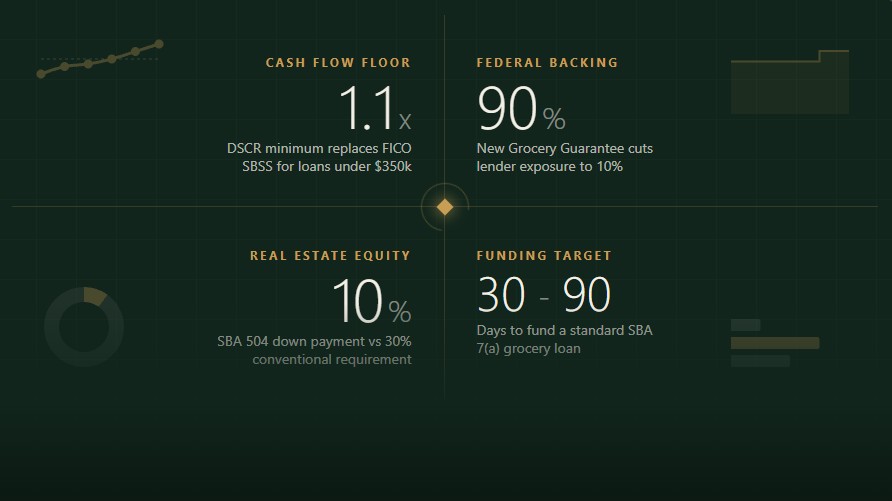
Most independent grocery startups use an SBA 7(a) loan for $300,000–$700,000 if they’re leasing, or an SBA 504 loan if they’re buying the building. Rates start at 11.75% for loans over $250,000, down payments run 10% for 504s (vs. 20–30% conventional), and approval takes 30–90 days depending on the program. [SBA, 2026] Understanding these options is crucial when determining how much it costs to open a grocery store.
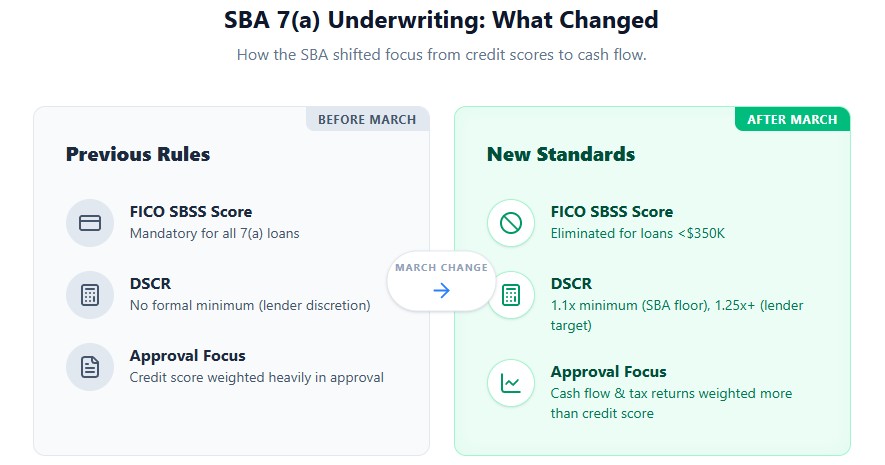
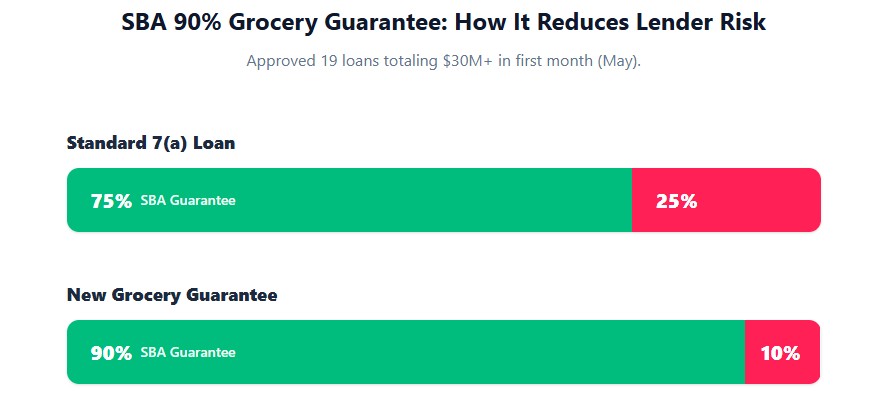
Two things changed in 2026 that make approval easier for some borrowers: the SBA retired the mandatory FICO SBSS credit score for loans under $350,000 (replaced with a 1.1x DSCR minimum), and launched a 90% federal guarantee specifically for grocery and food-supply-chain businesses. [SBA Policy Notice, 2026] That 15-point guarantee jump (from 75% to 90%) is often the exact difference between “we’ll pass” and “we’ll do this deal” — it cuts a lender’s exposure on a defaulted loan from 25% down to 10%.
Which Loan Fits Your Situation
| Your Situation | Best Fit | Why |
|---|---|---|
| Leasing a space, need buildout + equipment + inventory in one package | SBA 7(a) | Combines everything into one loan, $5M max, 10–25 year terms |
| Buying the building or a major piece of real estate | SBA 504 | Only 10% down (vs. 20–30% conventional), fixed rates, 20–25 year terms |
| Small mini-market, total need under $50,000 | SBA Microloan | Faster approval, 8–13% rates, no 2-year tax return requirement |
| Rural location, population under 50,000 | USDA B&I Guaranteed Loan | 80–85% guarantee (higher than SBA 7a’s 75%), lower rates for rural areas |
| Food desert / underserved urban or rural area | USDA HFFI / FARE Fund | Mix of loans, grants, and technical assistance for underserved areas |
| Grocery, food distribution, or cold storage — any size | Check SBA 90% Grocery Guarantee first | 90% federal guarantee (vs. 75% standard), 25-year terms on equipment/buildout |
| Refrigeration or POS equipment specifically, need funding in weeks not months | Equipment Financing | Equipment serves as collateral, 1–3 week approval, 8–20% rates |
Sources: SBA 7(a) and 504 program guidelines, USDA Rural Development B&I loan requirements, SBA International Trade Loan updates March–May 2026.
What Changed in 2026 (And Why It Matters More Than the Loan Type)
1. The SBA Retired the Mandatory FICO SBSS Score for Small 7(a) Loans
As of March 1, 2026, lenders are no longer required to use the FICO Small Business Scoring Service as the gatekeeping credit tool on 7(a) loans under $350,000. In its place, the SBA set a minimum Debt Service Coverage Ratio (DSCR) of 1.1x — meaning your business needs to generate at least $1.10 in annual cash flow for every $1.00 of debt payment on the new loan, combined with any existing debt. [EBIT Community, 2026]
How to calculate DSCR:
Formula: DSCR = EBITDA / Total Annual Debt Service
Example: If your EBITDA (earnings before interest, taxes, depreciation, and amortization) is $65,000 and your annual debt payment (new loan + existing debt) is $42,696 → DSCR = 1.52x. This clears the 1.1x SBA floor and most lenders’ 1.25x internal target with room to spare.
Calculate Your DSCR Before You Apply
What your store earns in a year before loan payments
Leave at $0 if this is your only loan
Works out to a $0 annual payment
Your store generates $1.25 for every $1.00 of debt payment.
In practice: if you’re applying for a $250,000 loan at 11.75% over 10 years, your actual monthly payment will be $3,558 ($42,696/year), not the $2,917/month you’d get from a naive calculation. Most banks will actually want to see 1.25x+ because the regulatory minimum is not the same as a lender’s comfort zone. What this means for you is that a business with strong, verifiable cash flow but a mediocre personal credit score now has a real path that didn’t exist as clearly before March 2026. It also means a good credit score no longer bails out a business whose numbers don’t support the payment — lenders are reading your tax returns and bank statements more closely than your score. This shift emphasizes the importance of robust grocery store cash flow management.
2. The SBA Launched a 90% Guarantee Specifically for Grocery and Food-Supply-Chain Businesses
Opened for applications May 1, 2026, the Grocery Guarantee is a retooled version of the SBA’s International Trade Loan program. It raised the federal guarantee on qualifying food-chain loans from the standard 75% (85% only on loans under $150,000) up to 90% — and it approved 19 loans totaling more than $30 million in its first month. [SBA Press Release, 2026] That 15-point jump matters because it cuts a lender’s actual exposure on a defaulted loan from 25% down to 10%, which is often the exact difference between “we’ll pass” and “we’ll do this deal.” It also allows a 25-year amortization on equipment and buildout financing, not just real estate — a meaningful detail if you’re financing a walk-in cooler or refrigerated cases, which normally get a 5–7 year equipment loan term.
Who qualifies: Grocery stores, supermarkets, and specialty food retailers (NAICS 445110, 445120, 445131, 445132), alongside farms, processors, and cold-storage/distribution operators — the eligibility list runs across roughly two dozen NAICS codes tied to the food supply chain.
Most lenders, and most of the cost/financing guides written before mid-2026, haven’t fully absorbed either change. It’s worth asking your lender directly whether they’re already underwriting to the new DSCR standard and whether your business qualifies under the Grocery Guarantee’s NAICS list before you assume you’re stuck with the old rules.
Step-by-Step: How to Apply for a Grocery Store Loan
Step 1: Check Eligibility (SBA Basic Requirements + Grocery-Specific)
Before you spend weeks gathering documents, confirm you meet the baseline:
- For-profit, U.S.-based operating business — startups qualify, but you’ll need a solid business plan and personal financial statements.
- Owner equity injection: 10–30% depending on loan type (10% for 504s, 20–30% for conventional commercial mortgages).
- DSCR minimum 1.1x (SBA floor) — most lenders want 1.25x+ for comfort.
- No delinquencies on federal debt (student loans, SBA loans, taxes).
- Grocery-specific: Confirm your NAICS code (445110 for supermarkets, 445120 for convenience stores, 445131 for meat markets, 445132 for fruit/vegetable markets). Misclassification is one of the fastest ways to have an application bounced back, especially when applying under a specialty program like the Grocery Guarantee. [U.S. Census Bureau, 2026]
- Inventory spoilage risk: Lenders discount perishable inventory collateral by 30–50% vs. dry goods. If you’re counting on $100K of inventory as collateral, expect the bank to value it at $50K–$70K for loan-to-value calculations. This is unique to grocery and catches first-time owners off guard. Learn more about managing shrinkage in grocery stores.
Step 2: Calculate Your DSCR (Formula + Example)
Formula: DSCR = EBITDA / Total Annual Debt Service
Example:
- Your EBITDA (from last 12 months P&L): $65,000
- New loan payment: $42,696/year ($3,558/month on a $250K loan at 11.75% over 10 years)
- Existing debt (if any): $10,000/year
- Total Annual Debt Service: $42,696 + $10,000 = $52,696
- DSCR: $65,000 / $52,696 = 1.23x
Verdict: 1.23x clears the 1.1x SBA floor but falls just short of most lenders’ 1.25x internal target. You’d need either (a) $2,000+ more in annual EBITDA, (b) a larger down payment to reduce the loan amount, or (c) a lender comfortable with 1.20–1.25x under the 90% Grocery Guarantee program.
Note: If you’re a startup with no historical EBITDA, lenders will use your projected year-1 cash flow — but expect heavier scrutiny and a higher equity requirement (20–30% vs. 10% for existing businesses).
Step 3: Find an SBA-Approved Lender
SBA loans are originated through approved lenders, not the SBA directly, and appetite varies enormously by bank. Use these tools:
- SBA Lender Match: Free tool that connects you with SBA-approved lenders in 48 hours.
- SBA Preferred Lenders: These banks have delegated authority to approve 7(a) loans without SBA review — faster closing (30–45 days vs. 60–90 days). [SBA Preferred Lenders, 2026]
- Certified Development Companies (CDCs): For 504 loans only — find one in your state via the National Association of Development Companies.
- USDA B&I Lenders: For rural locations — check USDA’s list of approved lenders by state.
- Franchise lenders: If you’re buying a franchise (Circle K, 7-Eleven, IGA), use SBA’s Franchise Directory to find lenders experienced with your brand. Franchise approval requires the brand’s SBA registration number and adds 2–4 weeks to underwriting.
Pro tip: Compare two or three offers. For a borderline file, it can be the difference between approval and decline — not just rate shopping.
Step 4: Gather Documents (Complete Checklist)
Having everything ready upfront cuts underwriting time by 2–4 weeks. Here’s what lenders typically require:
| Document Type | Details | Why It Matters |
|---|---|---|
| Business tax returns | Last 2–3 years (if existing business) | Verifies revenue, profitability, and cash flow trends |
| Personal tax returns | Last 2–3 years for all owners (20%+ stake) | Shows personal financial strength and ability to support the business |
| Year-to-date P&L and Balance Sheet | Dated within last 90 days | Current financial health — stale financials force follow-ups and delay approval |
| Business bank statements | Last 3–6 months, all pages | Verifies cash flow matches P&L, shows no hidden liabilities |
| Personal financial statement | SBA Form 413 for each owner | Lists assets, liabilities, net worth — used for collateral assessment |
| Business plan | 10–20 pages, includes market analysis, financial projections, management bios | Critical for startups — shows you understand the grocery business model and risks. See our grocery store business plan guide. |
| Debt schedule | List of all existing business debts (balance, monthly payment, maturity) | Used to calculate total debt service and DSCR |
| Use of funds breakdown | Specific line items: “$150K buildout, $95K refrigeration, $60K inventory, $45K working capital” | Vague language (“working capital”) reads as a red flag — specificity speeds underwriting |
| Lease agreement or purchase contract | Signed lease or real estate purchase agreement | Proves you have a location — lenders won’t fund without it |
| Resumes of key management | Store manager, owner/operator — highlight grocery/retail experience | Experience matters: a manager with 5+ years in grocery reduces perceived risk |
| Inventory aging report | Current inventory breakdown by category (produce, dairy, dry goods, frozen) | Lenders discount perishables 30–50% for collateral valuation — this shows they know what they’re lending against |
| Franchise Disclosure Document (FDD) | If buying a franchise: Items 1–23 of the FDD, SBA franchise registration number | Required for franchise approvals — adds 2–4 weeks to underwriting but streamlines collateral requirements |
Sources: SBA 7(a) application requirements, Bankrate business loan document checklist, Credibly loan requirements guide.
Step 5: Submit Application (What to Expect)
Once you submit, here’s the typical timeline:
| Program | Typical Funding Time | Notes |
|---|---|---|
| SBA 7(a) | 30–90 days | Preferred lenders: 30–45 days; standard 7(a): 60–90 days |
| SBA 504 | 60–120 days | Longer due to CDC involvement and real estate appraisal requirements |
| USDA B&I | 45–90 days | Faster for loans under $5M; rural areas may have fewer experienced lenders |
| Equipment Financing | 1–3 weeks | Equipment serves as collateral, minimal documentation, fast approval |
| SBA Microloan | 2–4 weeks | Nonprofit intermediaries have simpler processes, smaller loan amounts |
| Franchise (7-Eleven, Circle K, IGA) | 60–120 days | Additional 2–4 weeks for franchise brand approval and FDD review |
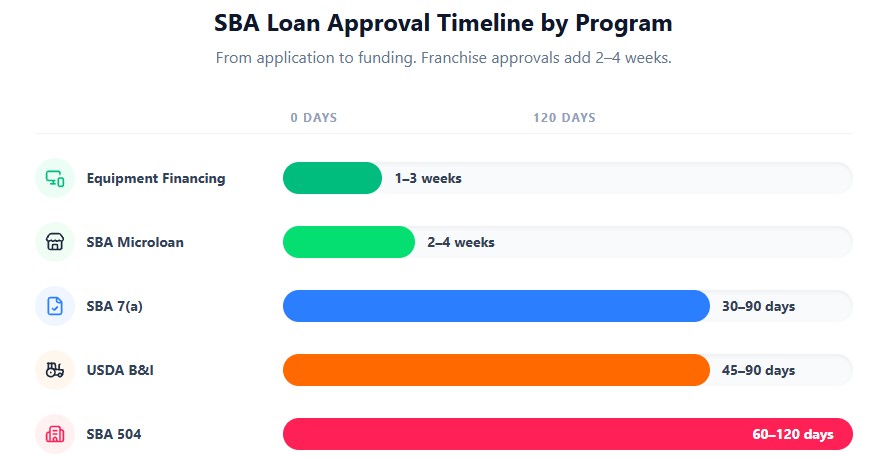
Sources: SBA loan processing times, Bankrate SBA loan guide, USDA B&I program timelines.
Step 6: Underwriting (Timeline, Follow-Ups)
During underwriting, expect 1–3 rounds of follow-up questions. Common requests:
- Clarification on large deposits in bank statements (gifts, loans, asset sales).
- Explanation of negative trends in revenue or profitability (seasonality, one-time events, market changes).
- Updated financials if your P&L is more than 90 days old by the time underwriting wraps up.
- Appraisal or environmental report for real estate purchases (504 loans).
- Verification of collateral (equipment invoices, real estate deeds, accounts receivable aging reports).
- Inventory valuation adjustment — expect the bank to discount perishable inventory (produce, dairy, meat) by 30–50% when calculating loan-to-value ratios. Dry goods (canned, boxed, frozen) get 70–90% valuation.
- Franchise brand approval — if you’re buying a franchise, the lender must verify the brand is on SBA’s Franchise Directory and request additional FDD documentation.
Pro tip: Respond to follow-ups within 24–48 hours. Every round of back-and-forth adds 1–2 weeks to your timeline.
Step 7: Closing & Funding (What Happens Next)
Once approved, you’ll sign loan documents and meet any closing conditions (insurance policies, lien filings, equity injection proof). Funding typically happens 3–10 business days after all conditions are met. For 504 loans, the bank funds its 50% portion first, then the CDC funds its 40% — expect a 1–2 week gap between the two disbursements.
SBA 7(a): The Default Choice for Most Grocery Startups
The 7(a) is the SBA’s general-purpose loan and the one most grocery owners end up using, because it can fund almost everything a new store needs in one package: buildout, equipment, initial inventory, and working capital.
| 7(a) Loan Size | Max Fixed Rate (2026) |
|---|---|
| $25,000 or less | 14.75% |
| $25,001–$50,000 | 13.75% |
| $50,001–$250,000 | 12.75% |
| Over $250,000 | 11.75% |
Based on a prime rate of 6.75% as of mid-2026. Variable-rate options run slightly lower on the largest loan tiers.
Good for: combining several needs into one loan — a corner-store or neighborhood-grocery startup that needs $300,000–$700,000 covering buildout, refrigeration, and opening inventory in a single package.
What lenders will ask for: 2–3 years of business and personal tax returns, a profit & loss statement and balance sheet dated within the last 90 days, and 3–6 months of business bank statements. If you’re a first-time owner buying an existing grocery store rather than starting from scratch, the seller’s historical financials carry real weight here — a store with three years of clean, verifiable cash flow is a fundamentally easier approval than a from-scratch startup projection.
The catch: collateral is typically required, and for loans over $350,000 the SBA still generally requires a first lien on business assets plus, often, a partial lien on the owner’s home equity if available. Personal guarantees are standard regardless of loan size. For grocery specifically, expect inventory to be discounted 30–50% for collateral purposes — a $100K inventory line might only count as $50K–$70K toward your loan-to-value ratio.
SBA 504: The Right Tool When Real Estate Is the Big Number
If you’re buying the building rather than leasing it — which more grocers are doing given how volatile commercial rents have gotten in grocery-anchored retail — the 504 is usually the better structure, not the 7(a). Consider whether to buy or lease commercial real estate based on your long-term strategy.
The 504 splits financing three ways: a bank funds roughly 50%, a Certified Development Company (CDC) funds around 40%, and you put down the remaining 10%. Compare that to a conventional commercial mortgage, which typically demands 20–30% down, and the appeal is obvious — that difference alone can free up $100,000+ in cash a new grocer would otherwise have to sink into a down payment instead of inventory and payroll. [SBA 504, 2026]
| Feature | SBA 504 |
|---|---|
| Structure | ~50% bank / ~40% CDC / ~10% borrower |
| Down payment | 10% (15% for startups or single-use properties) |
| Rate | Fixed for the life of the loan, historically starting near 5.5–5.7% on the CDC portion |
| Terms | 10, 20, or 25 years, fully amortized, no balloon payment |
| Max loan | $5 million ($5.5 million for green/energy-efficient projects) |
| Use of funds | Real estate, ground-up construction, major equipment — not working capital or inventory |
That last line is the one people miss: a 504 loan can’t fund your opening inventory or your first three months of payroll. If you’re buying the building, you’ll almost always be pairing a 504 with a separate line of credit, an SBA 7(a), or cash reserves to cover everything the 504 explicitly won’t touch.
A real example: an independent grocer in California used a 504 loan to buy the 17,000-square-foot building his store had been leasing, structured through a local Certified Development Company with a commercial bank partner. The draw wasn’t the loan amount — it was the 10% down payment versus the 30–40% a conventional commercial mortgage would have demanded, plus a fixed rate that locked in a predictable payment instead of riding a variable commercial rate for 20 years.
SBA Microloans: For the Corner-Store End of the Spectrum
If you’re opening something closer to a 1,500–2,000 sq ft mini-market, a full 7(a) is often more loan than you need — and more paperwork than the amount justifies. SBA microloans, administered through nonprofit intermediary lenders rather than banks, cap at $50,000 with rates typically running 8–13%. They’re a fit for a small buildout-plus-inventory package, especially for first-time owners without the two years of business tax returns a traditional 7(a) underwriter wants to see. The tradeoff is the cap — if your total need is closer to $150,000, you’ll outgrow a microloan fast and end up needing a 7(a) anyway. [SBA Microloans, 2026]
Franchise vs. Independent: Approval Differences That Matter
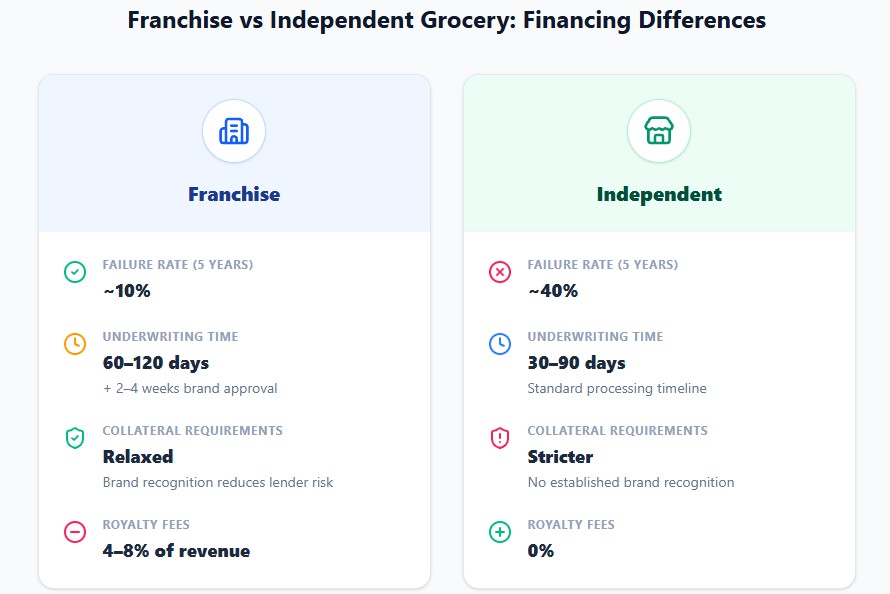
If you’re buying a franchise (Circle K, 7-Eleven, IGA, Piggly Wiggly) instead of starting an independent store, the SBA approval process changes in three critical ways:
| Factor | Franchise | Independent |
|---|---|---|
| Brand approval | Required: Brand must be on SBA Franchise Directory, adds 2–4 weeks to underwriting | Not applicable — no brand approval needed |
| Collateral requirements | Often relaxed: Established franchise brands reduce perceived risk, lenders may accept lower LTV | Stricter: No brand recognition, so lenders rely heavily on hard collateral and personal guarantees |
| Financial projections | Based on franchise FDD Item 19 (financial performance representations) — more credible to lenders | Based on your own market research and comps — requires more documentation and justification |
| Franchise fees | Can be financed into SBA loan (up to 20% of total loan amount) | Not applicable |
| Failure rate | Lower: Franchises have ~10% failure rate in first 5 years vs. ~40% for independent startups | Higher: No proven system, depends entirely on operator execution |
Bottom line: Franchises are easier to finance (lower perceived risk, FDD Item 19 data) but come with royalty fees (4–8% of revenue) that reduce your net margin. Independents have higher margins but face tougher underwriting and higher failure rates. Conducting a SWOT analysis can help you decide which path is right for you.
Alternatives Worth Knowing (Grocery-Specific)
USDA Business & Industry (B&I) Guaranteed Loans
If your store is in a rural area — USDA defines this as a population under 50,000 — the Business & Industry (B&I) Guaranteed Loan Program is worth checking before you default to an SBA loan. It guarantees up to 80% of the loan (85% for loans under $5 million obligated after October 1, 2025) for new construction, equipment, expansion, and working capital, with a one-time 3% guarantee fee and a 0.5% annual renewal fee.
Real grocery examples: a Kansas town used a $500,000 B&I loan to rebuild a grocery store after a fire; a New Mexico pueblo financed a $2.75 million supermarket replacing a 112-year-old building through this exact program. [Capital Bank, 2026]
USDA Healthy Food Financing Initiative (HFFI) / FARE Fund
Specifically for stores in food deserts — urban areas more than a mile from a grocery store, rural areas more than 10 miles out — the USDA’s Food Access and Retail Expansion (FARE) Fund offers a mix of loans, grants, and technical assistance for land, equipment, and building costs. It’s a five-year, $60 million initiative, and it’s underused simply because most first-time grocery owners never hear about it outside of rural economic development circles. If you’re opening in an underserved area, this is worth a call before you assume conventional financing is your only route.
Equipment Financing / Leasing
For refrigeration, POS systems, and shelving specifically, equipment financing lets the equipment itself serve as collateral, which speeds up approval and keeps your SBA borrowing capacity free for real estate and working capital. Rates run higher than SBA (often 8–20% depending on credit and term), but approval timelines are typically weeks, not months — useful if a walk-in cooler dies mid-buildout and you can’t wait for a loan committee. [Equipment Financing Calculator, 2026]
Rate breakdown by credit tier:
- 720+ FICO: 8–12% APR
- 650–720 FICO: 12–16% APR
- Below 650 FICO: 16–20% APR
Seller Financing
If you’re buying an existing store, the outgoing owner financing part of the purchase price — common in grocery, where many sellers are retiring rather than exiting a failing business — can fill the gap between what a bank will lend and what the deal actually costs, sometimes at better terms than a bank would offer on the same risk.
What to Avoid: Merchant Cash Advances
If you’re tempted by a merchant cash advance because approval is fast and credit requirements are loose, know what you’re actually paying: factor rates that typically translate to an APR of 40% to 150%+. For a business already running on 1.5–2.5% net margins, that cost structure is close to unsurvivable. Treat it strictly as a last resort, not a bridge.
Five Mistakes That Sink Grocery Loan Applications
- Guessing at your NAICS code. Misclassification is one of the fastest ways to have an application bounced back, especially when applying under a specialty program like the Grocery Guarantee. Confirm it with your accountant or lender before submitting anything. [U.S. Census Bureau, 2026]
- Vague use-of-funds language. “Working capital” or “general business expenses” reads as a red flag. “Two refrigerated delivery trucks and a 1,200 sq ft cold storage addition” moves through underwriting faster because it’s specific and verifiable.
- Stale or inconsistent financials. A P&L more than 90 days old, or one that doesn’t reconcile against your bank statements, forces a lender to stop and ask follow-up questions — and every round of follow-ups adds weeks.
- Applying to only one lender. SBA loans are originated through approved lenders, not the SBA directly, and appetite varies enormously by bank. Comparing two or three offers isn’t just rate shopping — for a borderline file, it can be the difference between approval and decline.
- Mixing personal and business expenses in your books. An underwriter needs a clean business P&L. If your car payment or family health insurance is buried in “miscellaneous,” untangling that after the fact costs you the exact weeks you don’t have when you’re trying to close on a time-sensitive property or equipment purchase.
FAQ: Common Questions About Grocery Store Loans
Can I get an SBA loan for a grocery store with bad credit?
Yes, but it depends on what “bad” means. After March 2026, the SBA removed the mandatory FICO SBSS score requirement for 7(a) loans under $350,000. Instead, lenders focus on your DSCR (minimum 1.1x, ideally 1.25x+). If your business generates strong cash flow but your personal credit is 600–650, you can still qualify — especially under the new 90% Grocery Guarantee, which reduces lender risk. However, most SBA lenders still want to see no recent bankruptcies, foreclosures, or delinquencies on federal debt.
How long does it take to get approved for an SBA 7(a) loan?
Typical funding time is 30–90 days. Preferred lenders (banks with delegated authority) can close in 30–45 days, while standard 7(a) loans through non-preferred lenders take 60–90 days due to SBA review. SBA 504 loans take longer (60–120 days) because they involve a CDC and real estate appraisal. Equipment financing is fastest (1–3 weeks) since the equipment serves as collateral. Franchise approvals add 2–4 weeks for brand review.
What is the minimum credit score for a grocery store loan?
There’s no official SBA minimum credit score, but most lenders want to see 640–680+ for 7(a) loans. After March 2026, credit score matters less than DSCR for loans under $350,000 — a business with 1.4x DSCR and 620 FICO can beat a business with 1.0x DSCR and 720 FICO. For equipment financing, 650+ FICO gets you 12–16% rates; below 650, expect 16–20% or higher.
Can I use an SBA 504 loan for equipment only?
Yes, but it’s rarely worth it for small equipment purchases. The 504 program is designed for major fixed assets (real estate, ground-up construction, large equipment over $500K). The minimum 504 loan is typically $500K+, and the process takes 60–120 days. For equipment under $500K, a 7(a) loan or equipment financing is faster and simpler.
What is the SBA 90% Grocery Guarantee?
Launched May 1, 2026, the Grocery Guarantee is a retooled version of the SBA’s International Trade Loan program specifically for food-supply-chain businesses. It raises the federal guarantee from 75% to 90%, cuts lender exposure from 25% to 10%, and allows 25-year amortization on equipment and buildout (not just real estate). Grocery stores, supermarkets, specialty food retailers, farms, processors, and cold-storage operators qualify (roughly two dozen NAICS codes). It approved 19 loans totaling $30M+ in its first month.
How do I calculate DSCR for an SBA loan?
Formula: DSCR = EBITDA / Total Annual Debt Service
Example: If your EBITDA is $65,000 and your annual debt payment (new loan + existing debt) is $52,696 → DSCR = 1.23x. The SBA minimum is 1.1x, but most lenders want 1.25x+ for comfort.
What documents do I need for an SBA grocery store loan?
Standard checklist: 2–3 years of business and personal tax returns, year-to-date P&L and balance sheet (within 90 days), 3–6 months of business bank statements, SBA Form 413 (personal financial statement), business plan (for startups), debt schedule, use of funds breakdown, lease or purchase agreement, and resumes of key management. Having everything ready upfront cuts underwriting time by 2–4 weeks. For franchises, add FDD Items 1–23. For inventory-heavy loans, add inventory aging report by category.
Bottom Line
For most independent grocery startups, the practical playbook looks like this: 7(a) if you’re leasing and need one loan to cover buildout, equipment, and inventory together; 504 if you’re buying the building and want to keep your down payment at 10% instead of 30%; USDA if you’re rural or in a food desert and haven’t checked eligibility yet; and the new 90% Grocery Guarantee checked against all of the above, because it’s specific to your industry and most lenders still aren’t leading with it five months after launch.
Whatever path you take, your books matter more than your pitch — with the FICO SBSS requirement gone for loans under $350,000, a lender is reading your cash flow and your debt service coverage ratio more literally than they were reading your credit score a year ago. Clean financials, dated within 90 days, with a specific and verifiable use of funds, will move faster through underwriting than a strong personal credit score attached to a vague ask. One grocery-specific caveat: expect your perishable inventory to be discounted 30–50% for collateral purposes, so don’t count on that full value when calculating your loan-to-value ratio. Understanding your unit economics and profit margins is essential for presenting a strong case to lenders. Also, ensure you have all necessary licenses and permits before applying. Don’t forget to review your tax strategy to maximize deductions. Finally, consider implementing a private label strategy to boost margins and improve your DSCR.