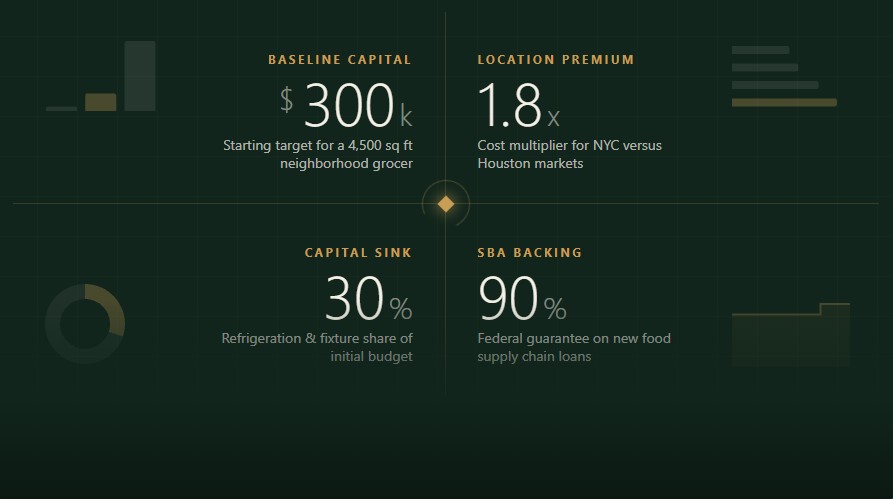
A small neighborhood grocery runs $300,000 to $700,000 before you sell a single item, a corner-style market can open for $80,000 to $180,000, and a full-scale supermarket easily clears $1.5 million. The gap comes down to five line items — real estate, refrigeration, inventory, labor, and licensing — and each one behaves differently depending on what you’re building and where. Understanding these costs is the first step in creating a solid grocery store business plan.
This breakdown also covers a brand-new SBA loan program specifically for grocery and food-supply-chain businesses that changes the financing math for anyone on the edge of approval. [SBA, 2026] For more details on financing options, see our guide on how to get a small business loan for a grocery store.
Types of Grocery Stores (and What They Actually Cost)
Most guides classify stores by size alone. In practice, format matters just as much as square footage. A 5,000 sq ft discount grocer (think ALDI) costs far less to open than a 5,000 sq ft full-service supermarket with deli, bakery, and prepared foods. [U.S. Census Bureau, 2026]
| Format | Typical Size | SKU Count | Key Features | Startup Cost (2026) |
|---|---|---|---|---|
| Corner / Convenience Store | 800–2,500 sq ft | 500–2,000 | Limited fresh, grab-and-go, often attached to gas station | $80,000 – $180,000 |
| Discount Grocer (ALDI-style) | 8,000–15,000 sq ft | 1,200–2,000 | Private-label heavy, limited SKUs, no service departments | $400,000 – $800,000 |
| Neighborhood Grocery (Independent) | 2,500–4,000 sq ft | 2,500–5,000 | Full departments (produce, dairy, frozen), 1–2 service counters | $300,000 – $700,000 |
| Specialty / Natural Foods | 5,000–12,000 sq ft | 4,000–8,000 | Organic/natural focus, prepared foods, juice bar, supplements | $500,000 – $1.2 million |
| Mid-Size Independent Supermarket | 8,000–15,000 sq ft | 10,000–15,000 | Deli, bakery, meat counter, seafood, pharmacy option | $700,000 – $1.5 million |
| Full-Service Supermarket (Kroger-style) | 25,000–50,000 sq ft | 25,000–40,000 | All service departments, pharmacy, floral, photo, fuel center | $1.5 million – $5 million+ |
The Seven Categories That Actually Drive the Number
1. Real Estate and Site Work
This is where the biggest variation happens — not just by city, but by condition of the space. A “vanilla box” (basic shell with utilities stubbed in) costs far less to finish than a raw shell or a former big-box store that needs complete reconfiguration. Deciding whether to buy or lease commercial real estate will significantly impact your initial capital requirements.
| Component | Cost Range | Notes |
|---|---|---|
| Site work & utilities | $50,000–$250,000 | Grading, parking lot, landscaping, utility connections. Can run 2–3× higher if soil remediation or major drainage work is needed. |
| Building shell (ground-up) | $180–$380/sq ft | Steel frame, concrete slab, roof, exterior walls. For a 5,000 sq ft store: $900K–$1.9M. Most independents lease existing space to avoid this. |
| Vanilla box / second-gen retail TI | $100–$200/sq ft | Core & shell with basic MEP, no interior finishes. For a 5,000 sq ft store: $500K–$1M. |
| Lease deposit (2–4 months) | $10,000–$95,000 | Varies by market. NYC: $62K–$95K for 4,500 sq ft. Houston: $20K–$27K for same size. |
| Annual rent (ongoing) | $15–$85/sq ft | National average: $24.69/sq ft. Dense metros (Manhattan, Miami): $55–$85/sq ft. Secondary markets (Houston, Columbus): $18–$24/sq ft. |
Buildout / renovation (interior only): This is the number people get wrong most often. A raw shell with no prior food-service use needs plumbing for produce misters, drains for the meat and deli area, and electrical capacity for a full refrigeration load — that’s a very different (and pricier) job than converting a former restaurant or retail space that already has grease traps and 3-phase power.
| Buildout Type | Cost per Sq Ft | Total for 2,500 sq ft | What’s Included |
|---|---|---|---|
| Basic (second-gen retail) | $50–$90/sq ft | $125,000–$225,000 | Flooring, paint, basic lighting, minimal plumbing/electrical updates. Assumes existing grease trap and adequate electrical service. |
| Medium (first-gen or partial food-service) | $90–$150/sq ft | $225,000–$375,000 | Full plumbing for produce/deli, electrical upgrades, ADA compliance, signage, HVAC modifications. |
| High-end (full-service supermarket) | $150–$280/sq ft | $375,000–$700,000 | All above + commercial kitchen (bakery, deli, prepared foods), specialized refrigeration, advanced fire suppression, custom millwork. |
2. Refrigeration and Equipment
This is the category that separates a grocery store from any other retail business, and it’s where most first-time operators underbudget.
| Equipment | Typical Cost | Notes |
|---|---|---|
| Walk-in cooler/freezer (10’×10′) | $15,000–$45,000 installed | Refrigeration unit alone is 30–40% of the total cost |
| Refrigerated display cases | $1,500–$3,000+ per unit | Industry rule of thumb: one case per 1,000 sq ft of store, so a 4,000 sq ft store needs 4+ |
| Shelving, gondolas, carts, baskets | $15,000–$40,000 | Scales directly with SKU count and store size |
| POS system (per lane) | $1,500–$5,000 per register (cloud-based) | Full supermarket-grade systems with inventory management: $35,000–$55,000 total |
| Scales, deli/meat case equipment | $10,000–$50,000 | Only if running a service deli or meat counter |
| Security system (cameras, EAS) | $5,000–$15,000 | Required by most insurers; scales with store size |
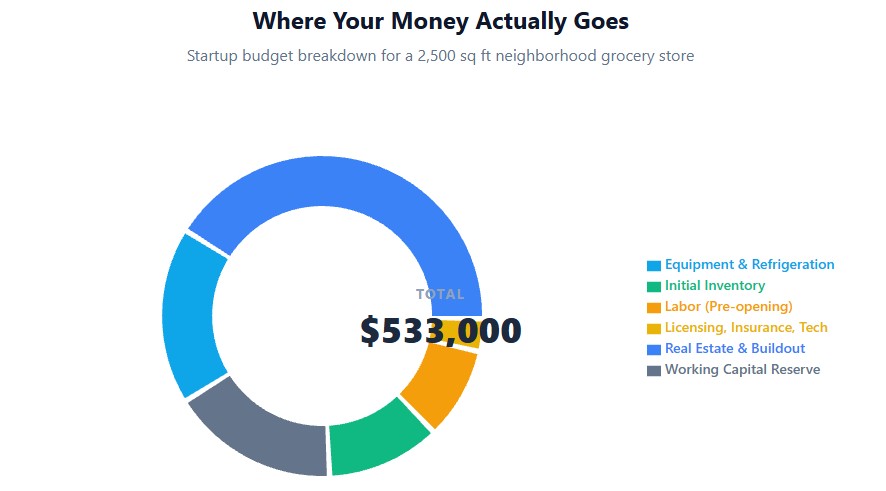
A rough rule that holds up across most of the small-grocer budgets we’ve seen: refrigeration and equipment eat 20–30% of total startup capital. If your equipment line is under 15% of your total budget, you’ve probably underbid it, not found a deal.
3. Initial Inventory and Wholesale Supply Chain
Most new grocery stores need $40,000 to $180,000 in opening inventory depending on size and category mix. A tight, curated 2,000-SKU store opens cheaper than a full 8,000-SKU conventional layout — but a store that opens under-stocked reads as “going out of business” to first-time customers, which is the fastest way to kill word-of-mouth before it starts. [U.S. Census Bureau, 2026] Managing this inventory effectively is crucial for maintaining a healthy inventory turnover ratio.
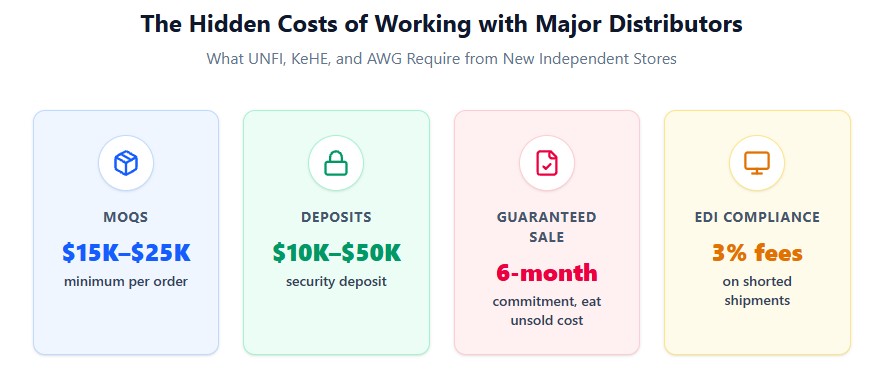
The barrier most guides skip: getting a contract with major distributors like UNFI, KeHE, or AWG. These wholesalers control access to 60%+ of national-brand SKUs, and they impose strict requirements on new independent accounts. [UNFI, 2026]
| Requirement | Typical Terms | Impact on Startup Capital |
|---|---|---|
| Minimum Order Quantities (MOQs) | $2,500–$5,000 per SKU / $15,000–$25,000 per order | Forces you to buy 2–3× more inventory upfront than you’d choose. A 3,000-SKU store might need $100K+ in opening inventory just to meet MOQs, not because it’s optimal. |
| Guaranteed Sale Commitments | 6-month guaranteed sale on new products (UNFI requirement) | You’re on the hook for unsold inventory. If a product doesn’t move in 6 months, you eat the cost — typically 10–15% of opening inventory value. |
| Deposit / Credit Requirements | $10,000–$50,000 security deposit or personal guarantee | Many distributors require new accounts to prepay first 2–3 orders or post a refundable deposit. This ties up working capital that could cover 1–2 months of operating losses. |
| EDI Compliance (KeHE, UNFI) | 98% inbound fill rate, 92% on-time delivery, EDI 850/856/810 transactions | Non-compliance triggers 3% fees on shorted shipments. New stores without experienced buyers often miss these targets in months 1–3, adding $3K–$10K in unexpected penalties. |
Workarounds for new independents:
- Regional wholesalers: Smaller distributors (not UNFI/KeHE) often have lower MOQs and no deposit requirements, but carry fewer national brands. Expect 5–10% higher unit costs.
- Buying co-ops: Joining IGA or Associated Wholesale Grocers (AWG) gives you access to pooled purchasing power and relaxed MOQs, but requires membership fees ($5K–$15K) and adherence to branding guidelines. [IGA, 2026]
- Direct-from-manufacturer: For high-volume categories (milk, bread, soda), going direct cuts out the distributor margin (8–12%) but requires even larger MOQs and dedicated storage.
| Format | SKU Count | Opening Inventory Cost | Distributor Deposit (Typical) |
|---|---|---|---|
| Corner / convenience | 500–2,000 | $25,000–$60,000 | $5,000–$15,000 |
| Neighborhood grocery | 2,500–5,000 | $40,000–$80,000 | $10,000–$25,000 |
| Mid-size supermarket | 10,000–15,000 | $100,000–$180,000 | $25,000–$50,000 |
| Full-service supermarket | 25,000–40,000 | $200,000–$400,000+ | $50,000–$100,000+ |
4. Licensing, Permits, and Insurance
This is where grocery differs from generic retail: you’re a food business in the eyes of regulators, not just a shop. Ensure you review our guide on grocery store licensing & permits for detailed state-by-state requirements.
| Requirement | Typical Cost | Timeline | Notes |
|---|---|---|---|
| Business registration / LLC formation | $500–$2,000 | 1–2 weeks | Varies by state; some states (NV, TX) are cheaper, others (CA, MA) run higher. |
| Retail food establishment / health permit | $200–$2,500 | Varies by county; inspection required before opening | NYC: $1,000–$2,500. Houston: $400–$1,000. |
| HACCP compliance (if prepared/hot foods) | $1,000–$5,000 | Plan development + staff training | Required for deli, hot bar, prepared foods. |
| Beer & wine license (off-sale, most states) | $400–$1,105 new application (CA) | Where allowed by quota, buying an existing license on the secondary market can run into five figures | Quota states (CA, PA, OH): secondary market licenses trade for $15K–$100K+. |
| General liability + property insurance | $3,000–$15,000/year | Higher with a deli, hot bar, or alcohol sales | NYC/SF: $8K–$15K. Houston/Chicago: $4.5K–$10K. |
| Workers’ comp | Varies by state and payroll | Mandatory in nearly every state with employees | Rates vary 2–3× by state (CA/NY highest, TX/FL lowest). |
The one people get blindsided by: if your county has a quota system on liquor licenses (common in parts of California, Pennsylvania, Ohio, and several other states), a new application costs a few hundred dollars — but if the quota is full, you’re buying an existing license from a private seller, and those routinely trade for $15,000 to well over $100,000 depending on the county. Check quota status before you build alcohol sales into your revenue plan, not after.
5. Staffing Before You Open
Payroll starts before your first sale. Budget for 2–6 weeks of hiring, training, and onboarding before opening day — for a neighborhood grocery with 8–15 employees, that’s typically $15,000–$40,000 in pre-revenue labor cost. Skimp here and you open with untrained cashiers and a deli team that’s never run the slicer under pressure, which shows up in your first month of reviews. [BLS, 2026]
Staffing by Format (Pre-Opening + First 3 Months):
| Format | Size | # of Employees (Opening) | Key Roles | Pre-Opening Labor Cost (4 weeks) | Monthly Payroll (Ongoing) |
|---|---|---|---|---|---|
| Corner / convenience | 800–2,500 sq ft | 3–6 | Store manager, 2–4 cashiers/stockers (part-time) | $6,000–$15,000 | $12,000–$25,000 |
| Discount grocer (ALDI-style) | 8,000–15,000 sq ft | 8–12 | Store manager, assistant manager, 6–10 cashiers/stockers | $20,000–$35,000 | $40,000–$70,000 |
| Neighborhood grocery | 2,500–4,000 sq ft | 10–14 | Store manager, assistant manager, department heads (produce, dairy), 6–10 cashiers/stockers, 1–2 deli/bakery | $25,000–$50,000 | $50,000–$90,000 |
| Specialty / natural foods | 5,000–12,000 sq ft | 15–25 | Store manager, 2–3 assistant managers, department heads (produce, prepared foods, supplements), 8–15 cashiers/stockers, 2–4 kitchen staff | $40,000–$80,000 | $80,000–$150,000 |
| Mid-size supermarket | 8,000–15,000 sq ft | 25–50 | Store manager, 3–4 assistant managers, 6–8 department heads, 15–30 cashiers/stockers, 4–8 deli/bakery/meat, pharmacy staff (optional) | $70,000–$150,000 | $140,000–$300,000 |
| Full-service supermarket | 25,000–50,000 sq ft | 75–150+ | Full management team, 10+ department heads, 40–80 cashiers/stockers, 10–20 service department staff, pharmacy, floral, photo | $200,000–$450,000 | $400,000–$900,000+ |
Wage Benchmarks (2026, by Role): [BLS, 2026]
| Role | National Avg. Hourly | Low-Cost Market (Houston, Columbus) | High-Cost Market (NYC, SF, LA) |
|---|---|---|---|
| Cashier / Stocker | $15–$18 | $13–$16 | $20–$24 |
| Lead Cashier / Front-End Supervisor | $18–$22 | $16–$19 | $23–$28 |
| Department Head (Produce, Dairy, Grocery) | $20–$26 | $18–$22 | $25–$32 |
| Assistant Store Manager | $22–$30 | $20–$26 | $28–$38 |
| Store Manager | $26–$40 | $22–$32 | $35–$55 |
| Deli/Bakery Clerk | $16–$22 | $14–$19 | $21–$28 |
| Deli/Bakery Manager | $24–$35 | $20–$28 | $30–$45 |
| Prepared Foods / Kitchen Staff | $17–$25 | $15–$21 | $22–$32 |
6. Technology Stack (2026 Requirements)
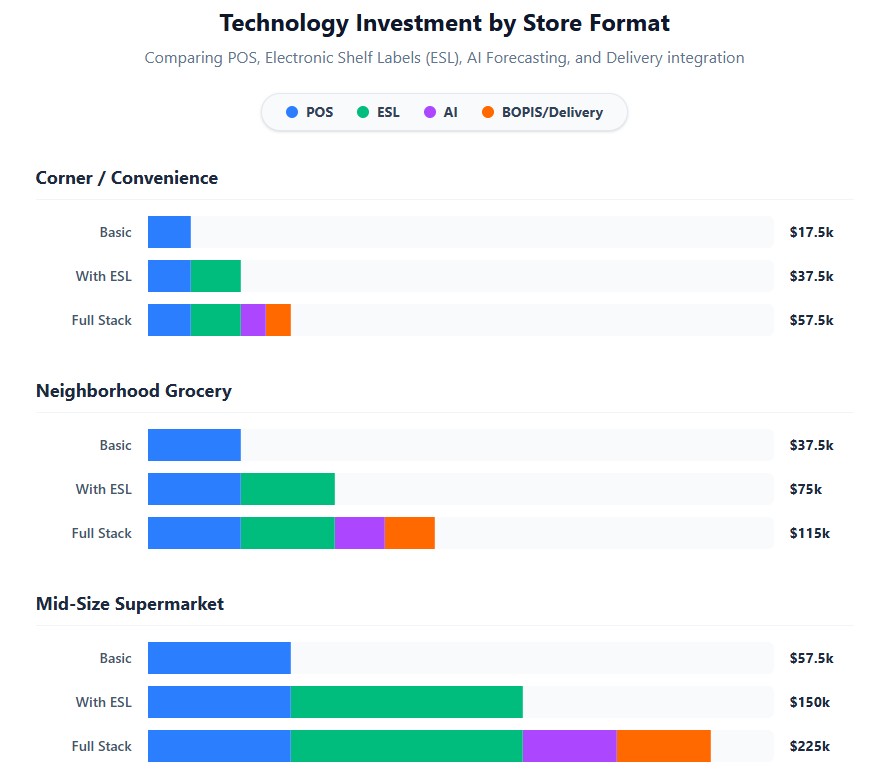
Cloud-based POS systems are table stakes, but modern grocery retail demands more. Here’s what a competitive 2026 store actually needs — and what it costs.
| Technology | Typical Cost | Notes |
|---|---|---|
| POS System (cloud-based, per lane) | $1,500–$5,000 per register | Full supermarket-grade systems with inventory management: $35,000–$55,000 total. Monthly SaaS: $150–$400/store. |
| Electronic Shelf Labels (ESL) | $15,000–$200,000+ (one-time) | E-ink labels: $8–$15/unit. A 4,500 sq ft store with 3,000 SKUs: $24,000–$45,000 for labels + $5,000–$10,000 for gateways + $2,000–$15,000 integration. Monthly SaaS: $150–$400/store. [ZKONG, 2026] |
| AI Inventory Forecasting | $5,000–$20,000 (one-time) + $200–$600/month | Tools like Afresh, Wasteless, or Shelf Engine integrate with POS to predict demand, reduce shrink, and automate ordering. Payback: 6–18 months via 15–25% shrink reduction. |
| Delivery Platform Integration (Instacart, DoorDash) | 0%–10% commission per order | Instacart: 5–10% commission on GMV for enterprise partners, 20–30% for small independents. DoorDash: 15–30% per delivery, 6% for pickup. Integration setup: $0–$5,000 depending on POS compatibility. [Miracuves, 2026] |
| BOPIS / Click-and-Collect Infrastructure | $10,000–$35,000 (one-time) | Dedicated pickup area signage, separate refrigerators for click-and-collect orders, order management software integration, mobile picking app for staff. 75% of BOPIS customers make additional in-store purchases at pickup, making this one of the highest-ROI omnichannel investments. [eMarketer, 2026] |
Technology budget by format:
| Format | Basic Tech (POS + Security) | With ESL | Full Stack (ESL + AI + BOPIS + Delivery) |
|---|---|---|---|
| Corner / convenience | $10,000–$25,000 | $25,000–$50,000 | $40,000–$75,000 |
| Neighborhood grocery | $25,000–$50,000 | $50,000–$100,000 | $80,000–$150,000 |
| Mid-size supermarket | $40,000–$75,000 | $100,000–$200,000 | $150,000–$300,000 |
7. Working Capital Reserve
The single most underfunded line item in every grocery startup budget we’ve looked at. Grocery runs on 1.5%–2.5% net margins even at maturity — a new store isn’t hitting that in month one, and most independent grocery stores take 18 to 39 months to reach sustained profitability. Effective cash flow management is critical during this period.
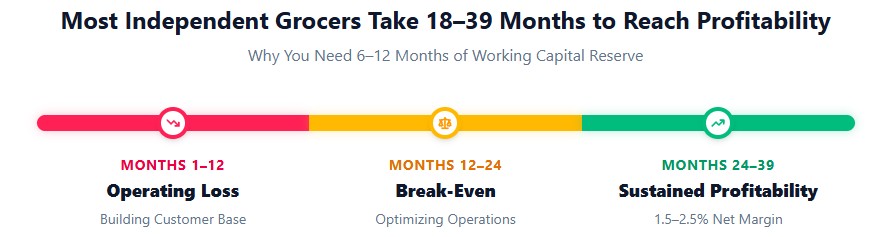
You need enough cash to cover 6–12 months of operating losses on top of your buildout budget, or you’re financing your own survival with the register. [U.S. Census Bureau, 2026] Use our break-even analysis tools to model your specific timeline.
| Format | Recommended Reserve (Months) | Dollar Amount (Typical Range) |
|---|---|---|
| Corner / convenience | 6 months | $50,000–$120,000 |
| Neighborhood grocery | 6–9 months | $100,000–$250,000 |
| Mid-size supermarket | 9–12 months | $250,000–$600,000 |
| Full-service supermarket | 12+ months | $600,000–$1.5M+ |
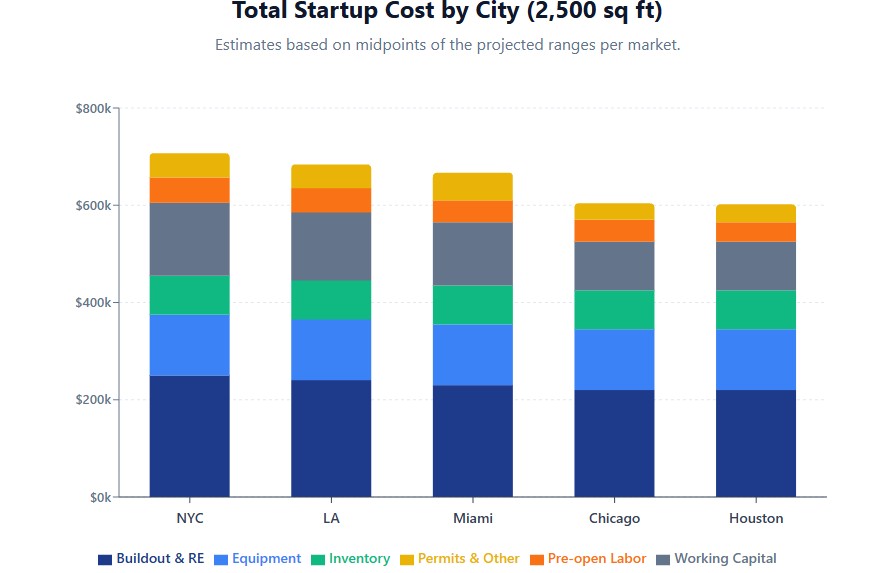
Cost by City: 2,500 sq ft Neighborhood Grocery (2026 Data)
The national averages above are a starting point, but your actual numbers will swing hard based on location. Rent in Manhattan runs 3–4× higher than Houston. Labor costs in San Francisco are nearly double those in Dallas. Even utility rates vary by 2–3× between states. [U.S. EIA, 2025]
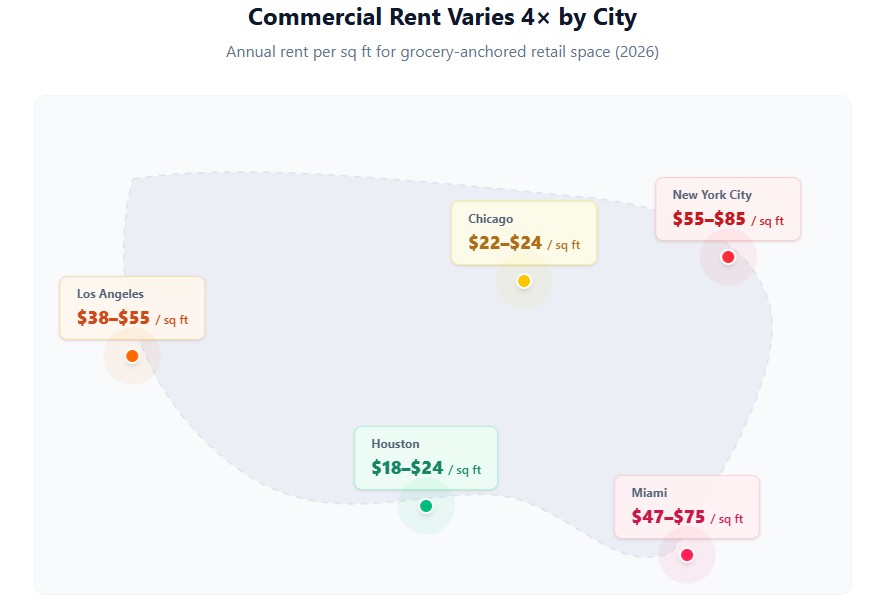
Note: All figures assume a 2,500 sq ft space in “vanilla box” or second-gen retail condition with medium buildout ($90–$150/sq ft). Annual rent and utilities are ongoing operating expenses, not upfront startup costs.
| Cost Category | New York City | Los Angeles | Chicago | Houston | Miami |
|---|---|---|---|---|---|
| Real Estate (upfront) | |||||
| Base rent ($/sq ft/yr) | $55–$85 | $38–$55 | $22–$24 | $18–$24 | $47–$75 |
| Lease deposit (3 months) | $34,500–$53,000 | $23,500–$34,500 | $13,500–$15,000 | $11,000–$15,000 | $29,500–$47,000 |
| Buildout (medium, $90–$150/sq ft, 2,500 sq ft) | $225,000–$375,000 | $225,000–$375,000 | $225,000–$375,000 | $225,000–$375,000 | $225,000–$375,000 |
| Equipment & Refrigeration | $85,000–$110,000 | $85,000–$110,000 | $85,000–$110,000 | $85,000–$110,000 | $85,000–$110,000 |
| Initial Inventory (2,500–3,500 SKUs) | $40,000–$60,000 | $40,000–$60,000 | $40,000–$60,000 | $40,000–$60,000 | $40,000–$60,000 |
| Licensing & Permits | |||||
| Business license + health permit | $1,250–$3,000 | $1,300–$3,000 | $600–$1,500 | $500–$1,300 | $800–$2,000 |
| Liquor license (beer/wine, new) | $1,500–$3,000 | $400–$1,105 | $750–$1,500 | $500–$1,200 | $800–$1,800 |
| Insurance (first year) | $8,000–$15,000 | $7,000–$14,000 | $5,000–$10,000 | $4,500–$9,000 | $6,000–$12,000 |
| Labor (pre-opening, 4 weeks)1 | |||||
| Avg. hourly wage (cashier/stocker) | $20–$23 | $21–$24 | $17–$19 | $15–$17 | $16–$19 |
| 12 employees × 160 hrs (4 weeks) | $48,000–$55,000 | $50,500–$57,500 | $40,000–$45,500 | $36,000–$41,000 | $38,500–$45,500 |
| Utilities (monthly estimate)2 | |||||
| Electricity (commercial rate ¢/kWh) | 19.4¢ | 25.6¢ | 12.2¢ | 10.6¢ | 12.5¢ |
| Monthly bill (8,000–20,000 kWh) | $2,000–$5,000 | $2,500–$6,500 | $1,200–$3,000 | $1,000–$2,500 | $1,200–$3,200 |
| Working Capital (6 months) | $120,000–$180,000 | $110,000–$170,000 | $80,000–$130,000 | $70,000–$120,000 | $90,000–$150,000 |
| TOTAL STARTUP (before opening) | $564,000–$851,000 | $543,000–$825,000 | $471,000–$738,000 | $473,000–$732,000 | $532,000–$803,000 |
1 Pre-opening labor cost includes blended management rates (store manager, assistant manager, department heads at $22–$35/hr) plus 20% payroll tax burden (workers’ comp, unemployment insurance, FICA match). Base cashier/stocker rates shown for reference only.
2 Monthly utility estimates include commercial demand charges ($/kW peak load) in addition to consumption charges (¢/kWh). Demand charges can add 30–50% to the base consumption cost for stores with heavy refrigeration loads.
Alternative Entry Models: Co-ops and Franchises
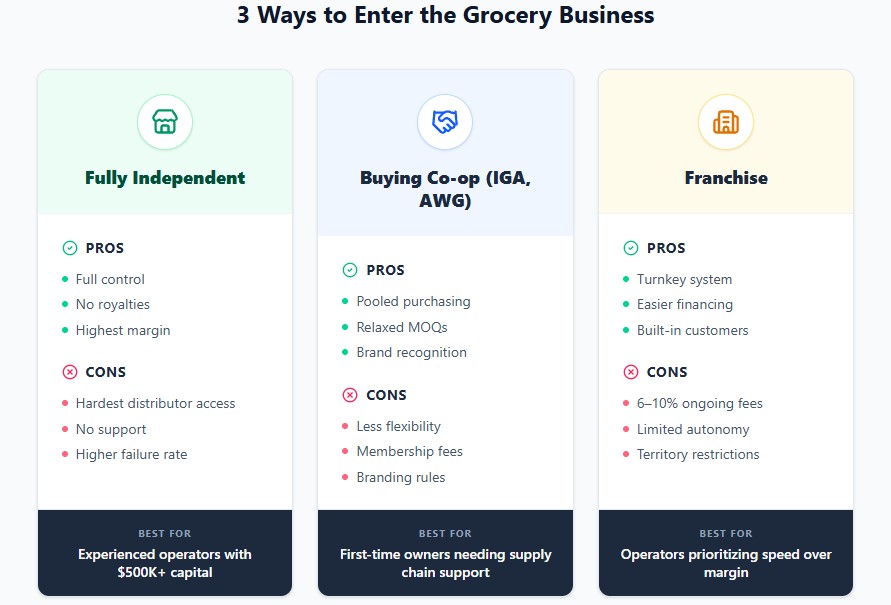
Going fully independent isn’t the only path. Here’s how the main alternatives compare:
| Model | Upfront Cost | Ongoing Fees | Pros | Cons |
|---|---|---|---|---|
| Fully Independent | $300K–$700K (neighborhood grocery) | None | Full control over branding, pricing, product mix. No royalty fees. Highest margin potential. | Hardest to secure distributor contracts. No built-in marketing or supply chain support. Higher failure rate in years 1–3. |
| Buying Co-op (IGA, AWG) | $300K–$700K + $5K–$15K membership | 1%–3% of purchases (co-op rebate structure) | Pooled purchasing power, relaxed MOQs, shared marketing, brand recognition (IGA banner). Training and support programs. [IGA, 2026] | Less flexibility on product mix and pricing. Must adhere to co-op branding guidelines. Membership fees reduce net margin by 0.5–1%. |
| Franchise (Save-A-Lot, Grocery Outlet) | $500K–$1.5M + $30K–$50K franchise fee | 4%–6% royalty + 2%–4% marketing fee | Turnkey model, proven systems, national supply chain, built-in customer base. Easier financing (banks know the brand). | High ongoing fees (6–10% of revenue). Limited autonomy. Franchise restrictions on territory and product mix. |
Financing: What’s Actually New in 2026
Most grocery startups are financed through some combination of personal savings, an SBA loan, and equipment financing for the big-ticket refrigeration purchases. The rates:
| SBA 7(a) Loan Size | Max Fixed Rate (2026) |
|---|---|
| $25,000 or less | 14.75% |
| $25,001–$50,000 | 13.75% |
| $50,001–$250,000 | 12.75% |
| Over $250,000 | 11.75% |
Rates calculated against the current prime rate of 6.75% as of mid-2026.
The Program Most Cost Guides Haven’t Caught Up On Yet
In May 2026, the SBA opened applications for the 90% Grocery Guarantee — a retooled version of its International Trade Loan program aimed specifically at food-supply-chain businesses, grocery retailers included. It approved 19 loans totaling more than $30 million in its first month alone, which is a fast start for a brand-new federal program. [SBA, 2026]
What it actually changes:
- Guarantee level: 90% of the loan is federally backed, versus the standard 75% on a regular 7(a) loan (85% only on loans under $150,000 in the standard program). That’s a real difference for a lender’s risk exposure — 25% down to 10% — and it’s specifically the kind of gap that turns a marginal file into an approved one.
- Loan size: Up to $5 million, same ceiling as standard 7(a).
- Term length: Up to 25 years, even for equipment and buildout — not just real estate. That matters directly for refrigeration: financing a $40,000 walk-in cooler over 25 years instead of the typical 5–7 year equipment loan term meaningfully lowers the monthly payment during your first, thinnest-margin years.
- Who it’s for: Grocery stores, supermarkets, and specialty food retailers qualify, alongside farms, processors, and cold-storage/distribution operators — the eligibility list runs across roughly two dozen NAICS codes tied to the food supply chain. [SBA Press Release, 2026]
The catch: it’s not a program you apply for directly through the government. You go through an SBA-approved lender, and if that lender turned you down for a standard 7(a) loan on a refrigeration purchase or buildout in the past year, it’s worth asking specifically whether the Grocery Guarantee changes their answer — a lot of lenders and even loan brokers still don’t have this program top of mind five months after launch.
Bottom Line
There’s no single number for “how much it costs to open a grocery store” because the format decides the number, not the industry. A corner market and a full-service supermarket sit $1.4 million apart in startup cost and share almost nothing operationally except the word “grocery.”
What holds across every format: refrigeration and equipment eat 20–30% of the budget whether you like it or not, licensing is more complex than standard retail because you’re a food business first, and the working capital reserve — the line everyone wants to shrink — is the one that decides whether you’re still open at month 18.
Location is the wildcard. A 2,500 sq ft neighborhood grocery costs $473K in Houston, $471K in Chicago, $532K in Miami, $543K in LA, and $564K+ in NYC — mostly driven by rent, wages, and utility rates. Use the city breakdown above to adjust your budget before you sign a lease. [U.S. EIA, 2025]
Format matters just as much as size. A 5,000 sq ft discount grocer (ALDI-style) costs 30–40% less to open than a 5,000 sq ft full-service supermarket with deli, bakery, and prepared foods. Choose your format before you finalize your budget.
Don’t skip the supply chain reality check. Distributor MOQs, deposits, and compliance requirements can add $20K–$100K+ to your opening inventory budget. Factor this in before you sign a lease, or you’ll be undercapitalized on day one.
If you’re financing any part of this through an SBA loan and you touch grocery, food distribution, or cold storage, check your NAICS code against the new 90% Grocery Guarantee before you assume a standard 7(a) loan is your only option — for a lot of borrowers on the edge of approval, it wasn’t available five months ago and it might change your answer now. [SBA, 2026] To improve your chances of approval, ensure you have a clear understanding of your unit economics and profit margins. Also, consider implementing a private label strategy to boost margins. Don’t forget to review your tax strategy to maximize deductions. Finally, conducting a SWOT analysis can help identify potential risks and opportunities early on. Managing COGS and minimizing shrinkage are also critical for long-term success.