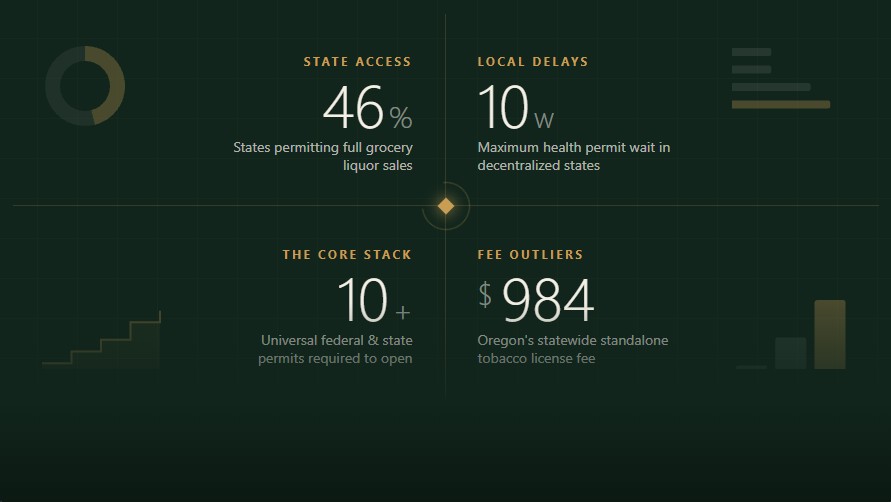
A grocery store needs two layers of licensing: a base stack that’s identical in every state, and a second layer — alcohol, container deposits, bag laws, food traceability — that depends entirely on your state and county. This covers both, with a full state comparison table and the application order that avoids the most common delays. Proper licensing is a critical component of your grocery store business plan and impacts your overall cost to open a grocery store.
Federal and Universal Requirements
| License / Permit | Issued By | Typical Cost | Notes |
|---|---|---|---|
| EIN (Employer Identification Number) | IRS | Free | Needed before you can open a business bank account or apply for most other licenses |
| Business entity registration (LLC, corp) | Secretary of State | $50–$500 | Varies by state and entity type |
| DBA / fictitious business name | County or state | $10–$100 | Only if operating under a name different from your legal entity |
| Retail Food Establishment License | State or county health department | $200–$1,000+ | Requires a pre-opening inspection; renewed annually with follow-up inspections. |
| Sales tax / seller’s permit | State Department of Revenue | Free–$100 | Required in every state except AK, DE, MT, NH, and OR. Find your state tax agency |
| Weights & measures registration | State department of agriculture or weights & measures office | $10–$50 per device, annual | Every scale and pricing device is certified against NIST Handbook 44 standards |
| Sign permit | Local zoning/building department | $50–$300 | Governed by local zoning code, not state law |
| Certificate of occupancy / fire inspection | Local fire marshal | $100–$500 | Required before you can legally open |
| Workers’ compensation insurance | State-mandated, private carrier | Varies by payroll | Mandatory once you have employees in nearly every state |
| Unemployment insurance registration | State department of labor | Free to register; ongoing tax | Required once you have payroll |
A general starting point for any state-specific license lookup is the SBA’s licenses and permits guide, which links out to each state’s business licensing portal. Ensure you also review our guide on grocery store licensing & permits for more detailed state-by-state requirements.
Alcohol Licensing by State
Alcohol licensing runs on three separate questions: whether your state is a control state (a state agency acts as wholesaler, and sometimes retailer, for some or all alcohol categories) or a license state (private retailers apply for a license, the state regulates but doesn’t own the supply chain); whether private retail is even allowed within a control state; and what specific category — spirits, wine, beer — grocery stores are permitted to sell. Understanding these regulations is crucial for your SWOT analysis and overall strategy.
The table below reflects each state’s current grocery alcohol access tier and control status. Even where the table shows a state permitting a category, county-level exceptions are common — Texas has wet, dry, and mixed counties; Kentucky has wet, dry, and “moist” counties; Georgia and South Carolina let counties restrict Sunday sales; Maryland’s rules shift county to county. Confirm with your specific county ABC office before finalizing a floor plan. Alcohol sales can significantly impact your profit margins and unit economics.
| State | Grocery Alcohol Access | Spirits Control | Notes |
|---|---|---|---|
| Alabama | Beer & wine only | Hard control | Wine above 14.9% ABV sold only in ABC stores |
| Alaska | None | — | |
| Arizona | Full (beer, wine, spirits) | — | |
| Arkansas | Beer & wine only | — | |
| California | Full | — | |
| Colorado | Beer & wine only | — | Spirits limited to liquor stores, with a small number of licensed exceptions |
| Connecticut | Beer only | — | Wine and spirits sold only at liquor stores |
| Delaware | None | — | |
| Florida | Beer & wine only | — | |
| Georgia | Beer & wine only | — | Sunday off-premises sales depend on local referendum |
| Hawaii | Full | — | |
| Idaho | Beer & wine only | Spirits only | Alcohol above 16% ABV sold through state dispensary or contract stores |
| Illinois | Full | — | |
| Indiana | Full | — | Cold beer restricted to liquor stores |
| Iowa | Full | Spirits only | |
| Kansas | Beer only | — | Capped at 6.0% ABV |
| Kentucky | Beer only | — | |
| Louisiana | Full | — | |
| Maine | Full | Spirits only | Agency liquor stores often integrated inside grocery/beverage stores |
| Maryland | Beer & wine statewide | Spirits only in liquor stores | Montgomery County has additional restrictions; grandfathered exceptions exist in some localities |
| Massachusetts | Full | — | |
| Michigan | Full | Spirits wholesale only | State keeps a wholesale monopoly on spirits |
| Minnesota | Beer only | — | Capped at 3.2% |
| Mississippi | Beer only | Hard control | |
| Missouri | Full | — | |
| Montana | Beer & wine only | Hard control | Wine above 16% ABV sold in state-contracted stores |
| Nebraska | Full | — | |
| Nevada | Full | — | 24-hour sales allowed |
| New Hampshire | Beer & wine only | Hard control, spirits only | Spirits sold in state-run stores, several at highway rest areas |
| New Jersey | None | — | Most chains capped at two liquor licenses statewide |
| New Mexico | Full | — | |
| New York | Beer only in most counties | — | Wine permitted in some counties with special licenses; wine and spirits sold only in liquor stores |
| North Carolina | Beer & wine only | Hard control, spirits only | Off-premises liquor hours 9 a.m.–9 p.m. |
| North Dakota | Full | — | Alcohol must be wall-separated from the rest of the store |
| Ohio | Beer & wine only | Spirits agent stores | Products under 21% ABV only |
| Oklahoma | Beer & wine only | — | |
| Oregon | Beer & wine only | Hard control, spirits only | Spirits sold through private stores acting as state agents |
| Pennsylvania | Beer & wine only | Hard control, spirits only | Beer/wine to go with a separate checkout; spirits only in state stores |
| Rhode Island | None | — | |
| South Carolina | Beer & wine only | — | Liquor sales end at 7 p.m., none on Sundays |
| South Dakota | Full | — | |
| Tennessee | Beer & wine only | — | |
| Texas | Beer & wine only | — | Hard liquor sold only in separate liquor stores |
| Utah | Beer only | Hard control | Capped at 4.0% ABW; stronger alcohol only through state-controlled stores |
| Vermont | Beer & wine only | Spirits only | Alcohol above 16% ABV sold through state liquor stores |
| Virginia | Beer & wine only | Hard control, spirits only | Some ready-to-drink cocktails permitted; spirits through Commonwealth stores |
| Washington | Full | — | Spirits limited to stores over 10,000 sq ft |
| West Virginia | Full | Spirits wholesale only | |
| Wisconsin | Full | — | |
| Wyoming | Full | — |
Categorization based on the Wikipedia list of U.S. alcohol laws and the NABCA Control State Directory, checked June 2026. For full regulatory detail and updates, see the NIAAA Alcohol Policy Information System.
Even in a full-access state, if your county runs a quota system on alcohol licenses, a new application typically runs a few hundred dollars, but buying an existing license on the secondary market in a quota-restricted county can run $15,000 to well over $100,000.
Tobacco and Lottery Retail Permits
Both are high-traffic, high-margin categories that most licensing checklists skip entirely. These can be significant contributors to your profit centers.
Tobacco: 40 states require a standalone tobacco retail license, separate from your general business license. Fees vary enormously — most states run $15–$200, but a few outliers charge far more: Oregon’s statewide license runs $984 as of January 2026, and California’s fee rises to $450 per location on July 1, 2026 (up from $265). Every location needs its own license; a multi-store operator can’t share one. Federal law sets the minimum purchase age at 21 nationwide (Tobacco 21, enforced by the FDA Center for Tobacco Products), on top of whatever your state license requires.
Lottery: Five states have no lottery at all — Alabama, Alaska, Hawaii, Nevada, and Utah — so this doesn’t apply if you’re opening there. Everywhere else, you apply directly through your state lottery commission, not a general licensing body. Expect a background and credit check, a joint bank account the state can sweep for proceeds, and in some states a surety bond if you don’t meet the commission’s financial responsibility standards. Retailers typically earn a commission of around 5–6% on ticket sales plus bonus commissions for selling large winning tickets. Processing commonly takes about three weeks once a complete application is submitted.
Meat Counter & Processing Exemptions (USDA FSIS)
If your grocery store cuts, grinds, or processes fresh meat on-site, you are typically exempt from full-time, continuous federal inspector oversight under the USDA FSIS Retail Exemption (9 CFR § 303.1(d)). Managing this department effectively is key to controlling shrinkage.
Under this exemption, your butcher counter operates primarily under local/state health department jurisdiction, provided that:
- At least 75% of your meat product sales are made directly to individual household consumers.
- Wholesale sales to non-household entities (such as local hotels, restaurants, and institutions) do not exceed the annual federal dollar thresholds published in the USDA FSIS Retail Exemption Notice.
For full operational requirements and boundaries between retail and custom processing, consult the official USDA FSIS Livestock Exemption Guidance.
Seafood Departments
A counter that just portions and repackages already-processed fish typically falls under your state retail food code, the same as any other department — the FDA’s mandatory Seafood HACCP rule targets processors and importers, not retail counters doing simple cutting. That changes the moment you do specialized processing on-site: smoking, curing, vacuum or reduced-oxygen packaging, or preparing raw fish for raw consumption (sushi). Any of those typically require a state-approved HACCP variance plan. Sushi specifically triggers the FDA Food Code’s parasite-destruction requirement — raw fish intended for raw consumption generally needs freezing at -4°F for 7 days, or -31°F for 15 hours, before service, and inspectors will ask for records proving it happened.
Bottle Deposit and Plastic Bag Laws
Bottle deposit states (10, plus Guam): California, Connecticut, Hawaii, Iowa, Maine, Massachusetts, Michigan, New York, Oregon, and Vermont require retailers to either accept container returns and pay out the deposit at point of sale, or register an exemption directing customers to a certified redemption center. Retailers that accept returns are generally owed a per-container handling fee from distributors — register properly or that money goes unclaimed. Massachusetts and New York both have active 2026 legislation to raise the deposit from 5 to 10 cents; Oregon expanded its bottle bill to include canned wine in mid-2025. Details by state: NCSL beverage container deposit law summary.
Plastic bag ban states (12, as of January 2026): California, Colorado, Connecticut, Delaware, Hawaii, Maine, New Jersey, New York, Oregon, Rhode Island, Vermont, and Washington prohibit single-use plastic bags at checkout, typically requiring a $0.05–$0.12 fee on paper or heavier reusable bags instead. California closed a loophole on January 1, 2026 (SB 1053): thicker “reusable” plastic bags, previously sold for a dime and treated as disposable by most shoppers, are no longer allowed — California checkouts are now paper-bag-only. Washington, D.C. charges a bag fee but has not enacted a full ban.
Foam foodware bans are expanding separately from bag laws: New York’s polystyrene ban now covers cold storage containers (coolers, ice chests) as of January 2026, and Virginia’s expanded foam-container ban applies to all food vendors starting July 1, 2026.
Food Traceability Requirement (FSMA 204)
The FDA’s Food Traceability Rule requires businesses handling specific high-risk foods — leafy greens, shell eggs, certain cheeses, ready-to-eat deli salads, and other items on the FDA Food Traceability List — to produce detailed chain-of-custody records within 24 hours on request. The compliance date, originally January 20, 2026, was extended by 30 months to July 20, 2028.
That federal date is not necessarily your operating date. Walmart, Kroger, Albertsons, Sam’s Club, Target, and distributor KeHE have all moved to require supplier traceability data ahead of, and broader in scope than, the federal rule itself. If your store buys through a major distributor rather than sourcing independently, that distributor’s contract terms — not the FDA’s 2028 date — determine when you actually need to comply. Ask your distributor directly what they require now.
Retail food establishments with 10 or fewer full-time employees may qualify for an exemption from parts of the rule — confirm your status directly with the FDA rather than assuming.
SNAP and WIC Authorization
These are two separate federal programs with two separate application processes. SNAP participation can significantly influence your cash flow management due to reimbursement timing.
SNAP: A single federal authorization through the USDA Food and Nutrition Service. One national application, typical review window around 45 days.
WIC: A state-administered vendor agreement, applied for separately through your state’s WIC agency. Each state sets its own minimum stocking requirements and application cycle — some run rolling applications, others open enrollment windows only periodically, occasionally with a waitlist. SNAP authorization does not carry over to WIC; they are unrelated applications.
How to Apply: Step-by-Step
- Register your business entity with your Secretary of State (LLC or corporation) before applying for anything else — most other licenses require a registered entity name.
- Get your EIN from the IRS. Free, done online, usually issued same-day.
- Confirm zoning and get your Certificate of Occupancy from the local building/zoning department before signing a long lease — a location that isn’t zoned for retail food sale needs a variance, which can add months. Consider whether to buy or lease commercial real estate based on these zoning constraints.
- Apply for your sales tax / seller’s permit through your state Department of Revenue (skip this step only in AK, DE, MT, NH, or OR).
- Apply for your Retail Food Establishment License through your state or county health department and schedule the pre-opening inspection early — inspector availability, not paperwork, is usually the pacing item.
- Register weights & measures devices — every scale and pricing device — with your state’s weights & measures office.
- Apply for your alcohol license, if applicable, through your state ABC board. Start this early if your county runs a quota system; waitlists and secondary-market purchases take substantially longer than a standard application.
- Apply for your tobacco and lottery retail permits separately, if applicable — these run through your state’s tax/revenue agency (tobacco) and lottery commission (lottery), not your general business license.
- Confirm your meat department’s regulatory status before buildout if you’re running a butcher counter — most grocery meat departments qualify for the USDA retail exemption (9 CFR § 303.1(d)), but confirm your sourcing (federally or state-inspected) and wholesale-sales limits with USDA FSIS or your state department of agriculture.
- Apply for SNAP authorization through the USDA Food and Nutrition Service (budget roughly 45 days).
- Apply for a WIC vendor agreement separately through your state WIC agency, if relevant to your market — check your state’s enrollment window rather than assuming rolling admission.
- Register for workers’ compensation and unemployment insurance once you bring on your first employee.
- Schedule your final fire marshal and health inspections before your opening date — these are the two approvals that typically gate your certificate of occupancy.
Health Department Plan Review Checklist
Before a health department (or, in states that split the function, an agriculture department — see below) will schedule your pre-opening inspection, most jurisdictions require a plan review submission. Requirements vary in detail, but the core packet is consistent across states because most retail food codes are modeled on the FDA Food Code:
- Scaled floor plan showing food prep areas, storage, restrooms, and handwashing sink locations
- Equipment list with make/model and NSF certification for coolers, prep tables, sinks, and any deli or hot-food equipment
- Product/menu list — for a grocery store, this means listing which departments you’ll operate (packaged goods only vs. deli, hot bar, meat cutting, bakery), since each added department triggers additional plumbing, ventilation, and certification requirements
- Water and sewage documentation — proof of approved public water/sewer connection, or septic approval if not on public utilities (explicitly required in Florida’s FDACS process, and typical elsewhere)
- Certified Food Protection Manager documentation — at least one person on staff needs an accredited food safety certification (ServSafe or state-equivalent); California requires this within 30 days of hire, Texas within 30 days of hire
- Employee food handler cards, where your state mandates them (California, Texas, Oregon, Washington, Illinois, Utah, Alaska, Hawaii, and Florida all have statewide requirements)
- Pest control contract with a licensed exterminator — most jurisdictions want this on file before the first inspection, not after
- Grease trap / plumbing plan, if you’re running a deli, hot bar, or any grease-generating equipment
- HACCP plan, only if you’re doing specialized processing on-site — smoking, curing, reduced-oxygen packaging, or sushi preparation
Incomplete plan review packets are the single most common cause of inspection delays — submitting all of the above up front, rather than in response to follow-up requests, is the fastest way through this step.
State-by-State Licensing Timelines
There’s no single national number because the biggest variable isn’t paperwork — it’s whether your state runs food licensing through one centralized agency or delegates it to individual counties and cities. Centralized states publish one timeline; decentralized states mean your actual wait depends on which county you’re in.
| State | Typical Timeline | Basis |
|---|---|---|
| Florida | 3–5 weeks | Centralized: FDACS licenses grocery/retail food stores directly (a separate agency from DBPR, which handles restaurants). Field contact within 3–5 business days of application, on-site inspection typically within 2 weeks; FDACS recommends submitting 21 days before opening. |
| New York City | 22+ days minimum | Centralized within NYC: you may legally begin operating 22 days after submitting your application, before the permit is even issued — the NYC Health Department conducts an unannounced pre-permit inspection afterward. |
| New York State (outside NYC) | 3–4 weeks (permit) | The statewide DOH food service establishment permit processes in 15–30 days. Note: grocery and retail food stores specifically are licensed through the NYS Department of Agriculture and Markets, not the Department of Health — confirm which agency applies to your store type. |
| Texas | 4–8 weeks | Decentralized: no single state retail food permit — cities and counties issue their own. State-level registrations (sales tax, entity formation) typically clear in 4–6 weeks; total timeline depends on your local health department’s inspection queue. |
| California | 6–10 weeks | Decentralized: food facility permits are issued by county environmental health departments, not the state. General local business licensing runs 2–4 weeks; add county inspection scheduling on top, which runs longer in high-volume counties (Los Angeles, the Bay Area) than in smaller ones. |
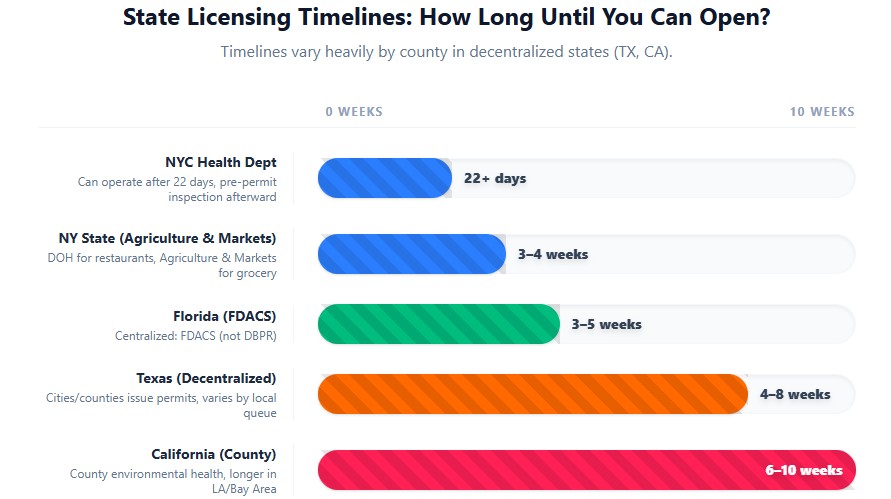
Two takeaways worth acting on: first, several states — Florida and New York among them — license grocery and retail food stores through a different agency entirely than the one that licenses restaurants, so a generic “food license timeline” you find online may not apply to your store type at all. Second, in decentralized states (Texas, California, and most others), your actual timeline is a function of your specific county’s inspection backlog, not a statewide number — call your local health department directly for a realistic estimate before finalizing a buildout schedule.
Licensing Mistakes That Actually Happen
- Assuming “alcohol is allowed” means all three categories. A state that permits beer and wine in grocery stores is not automatically a state that permits spirits.
- Treating SNAP authorization as WIC authorization. They’re separate applications through separate agencies with separate timelines.
- Letting scale certification lapse. Weights & measures registration requires periodic recertification per device, not a one-time filing.
- Skipping bottle bill handling-fee registration. In deposit states, retailers that accept returns are generally owed a per-container fee from distributors; unregistered stores leave that money unclaimed.
- Waiting on FSMA 204 because “the deadline is 2028.” If your distributor is a major national chain or wholesaler, their contract terms are the deadline that actually applies to you.
- Assuming a general business license covers tobacco or lottery sales. Both require standalone permits through different agencies (state tax/revenue for tobacco, the state lottery commission for lottery), each with its own application and renewal cycle.
- Not confirming the sourcing behind the retail exemption. A meat department that grinds or cuts product from an uninspected source doesn’t qualify for the USDA retail exemption — the carcass or wholesale cut has to come from an already-inspected supplier.